

Research Projects
Since 2016, Les Ponts Jacques Cartier and Champlain Incorporated (PJCCI) has overseen several research projects focusing on methods, materials and innovation to improve the durability, performance and longevity of its infrastructures.
Deconstruction of the original Champlain Bridge
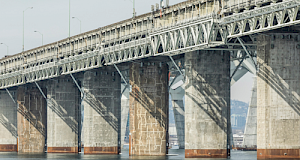
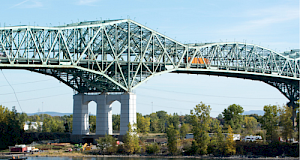
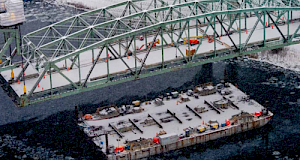
The deconstruction of the original Champlain Bridge represented a unique opportunity to significantly advance knowledge of infrastructure performance and sustainability. After a competition among Canadian research bodies launched in June 2019, JCCBI selected ten projects that were carried out during the deconstruction.
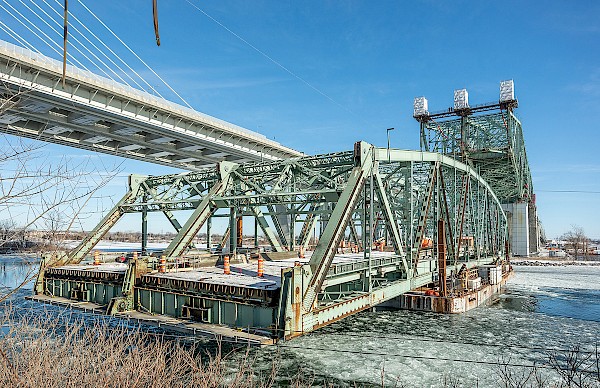
Experiments and Design Guidelines for Repair and Strengthening of Steel Bridges Using Externally Bonded Poot High Modulus Carbon-FRP Plates
+ Researchers: Brahim Benmokrane (Universite de Sherbrooke) / Omar Chaallal (Ecole de technologie supérieure)
+ Researchers body: Université de Sherbrooke
Description
Carbon fibre reinforced polymers (CFRP) are increasingly used to rehabilitate concrete infrastructure, but so far this material has not been used on steel structures. However, CFRP offer many advantages because of their high rigidity compared to more conventional methods (bolting and welding), and they are starting to be used to rehabilitate steel structures.
Goals
Study the feasibility of using CFRP to repair steel structures and develop analytical models to reliably predict the contribution of CFRP to strength, while estimating the service life of this type of reinforced steel components under cyclic fatigue loads.
Results
The project allowed for documenting the environmental performance and bond behaviour of HM/UHM-CFRP systems applied to steel, for studying bond-slip behaviour and anchor rage lengths, for assessing the strength of G40 steel components and components removed from the original Champlain Bridge, and for addressing fatigue repair on cracked plates. The final deliverable contains design guidelines and recommendations for ensuring a durable installation.
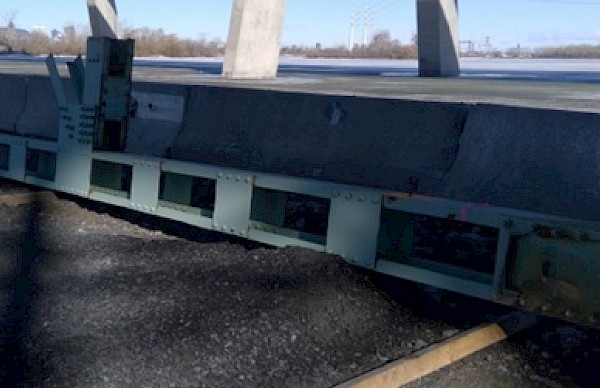
Performance Assessment of Painting sag Applied to Steel Structures
+ Researcher: Nafiseh Ebrahimi (NRCC)
+ Researcher Body: National Research Council of Canada (NRCC)
Description
The painting of steel bridges plays a significant role in preserving these structures against long-term corrosion. For this study, samples of steel components from the Champlain Bridge will be studied in the laboratory, while historical data on surface preparations, different types of paint, as well as climate conditions will be examined to understand long-term deterioration.
Goals
Assess the impact of complex parameters that have affected the performance of paint applied to the bridge and issue recommendations for improvements that are applicable to JCCBI’s other steel structures and to the structures belonging to other managers.
Results
Analysis of coated steel elements from the original Champlain Bridge provided valuable insights into corrosion mechanisms. Statistical analyses, including Pearson and Spearman correlation methods, confirmed that corrosion is influenced by multiple interacting factors. While chlorides from de-icing salts contribute directly to deterioration, coating application deficiencies—such as inadequate surface preparation and uneven coating thickness—create localized weaknesses that accelerate corrosion. Ultimately, the study highlights that successful corrosion protection depends not only on coating selection, but also on reliable application practices and long-term maintainability.
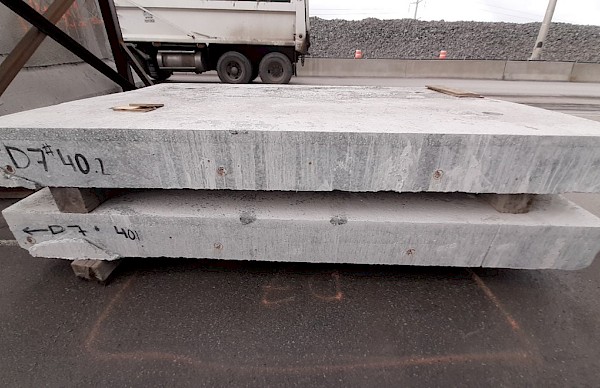
Evaluation of the Real Condition and Mechanical Performance and Durability of Concrete Elements of the Bridge
+ Researchers: Benoit Fournier and David Conciatori (Universite Laval)
+ Research body : Université Laval
Description
For the managers of civil engineering structures, diagnosing actual condition and future behaviour is a major challenge. This project aims to implement a multidisciplinary analysis of the condition assessment of concrete components of the bridge through destructive and non-destructive methods, with a focus on problems related to corrosion and alkali-aggregate reaction.
Goals
Better understand the influence of exposure Conditions on the causes, magnitude, and mechanisms of degradation on different concrete structural components to better calibrate a predictive damage model.
Results
The project determined the current condition of several concrete components of the Champlain Bridge, as well as the potential for future damage to such components. It involved mechanical, petrographic, residual expansion and non-destructive testing on cores. The results will help improve the management of aging structures affected by alkali-silica reaction, freeze-thaw cycling and other deterioration mechanisms.
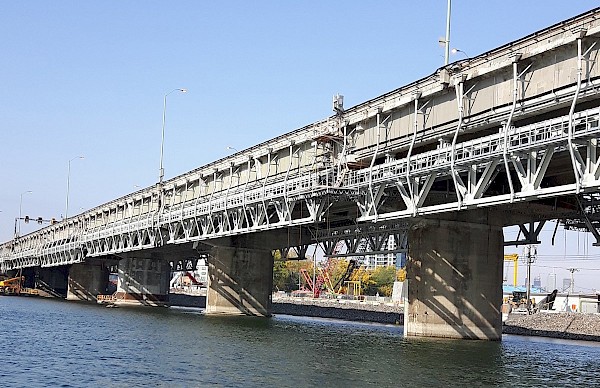
Improvement of Hysteretic Behaviour of Fretted Elastomeric Bearings for Seismic Isolation of Bridges
+ Researchers: Loth Guizani (ETS)
+ Research body: Ecole de technologie supérieure (ETS)
Description
In areas with moderate seismic activity, such as most of Quebec, basic seismic isolation using fretted bearings appears to be an effective solution. However, the absorption rate from fretted bearings remains limited. An evaluation of the hysteretic characteristics of the bridge’s fretted bearings under various load and temperature conditions will be carried out to develop avenues for improvement.
Goals
Efficiently improve the absorption rate of fretted bearings and study the long-term reliability of structures with a collection of behavioural data.
Results
The project made it possible to better understand the hysteretic behaviour of laminated bearings at low temperatures, to quantify the stiffening and aging of natural rubber, to develop a means of extracting test specimens from recovered bearings and to test the behaviour of bridge bearings with U-shaped metallic dampers.
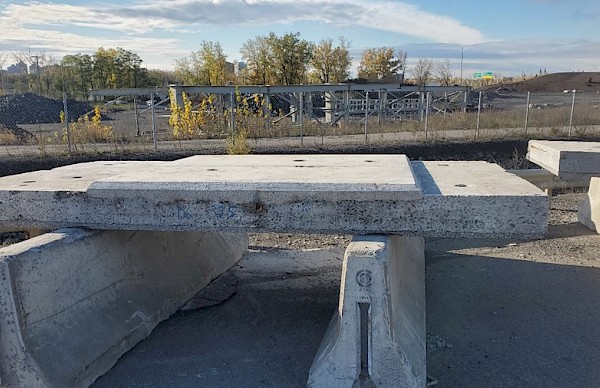
Critical Analysis and Performance Monitoring of Surface Repairs of Concrete Elements
+ Researchers: Richard Gagne (Université de Sherbrooke) | Benoit Bissonnette (Universite Laval)
+ Research body: Universite de Sherbrooke
Description
The different surface repairs of concrete elements applied to the bridge in recent years show varying levels of durability and behaviour, The project components include damage mapping, the sampling of different bridge elements, and laboratory characterization.
Goals
Evaluate the performance of surface repairs of concrete elements while accounting for repaired damage, the type of surface preparation, materials or products, deployment techniques and climate conditions.
Results
Residual expansion tests, combined with the Damage Rating Index (DRI), showed that alkaline solution testing provided more reliable results than humid-air exposure. A linear relationship between expansion and damage was identified, leading to estimated in-situ expansions of 0.20% to 0.45%, exceeding the 0.20% threshold associated with steel yielding in some areas. The findings provide practical guidance for prognosis testing, coring strategies, and the interpretation of ASR-related cracking.
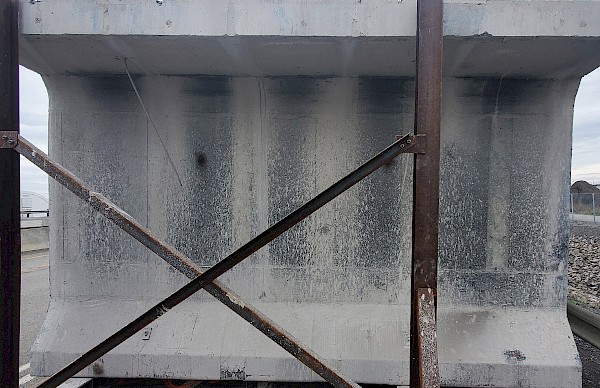
Evaluation of the Performance of CFRP Reinforcements and Development of a Model for Predicting Their Lifetime
+ Researchers: Radhouane Masmoudi (Université de Sherbrooke)
+ Research body: Université de Sherbrooke
Description
Carbon-fibre-reinforced polymers (CFRP) were widely used on the Champlain Bridge as a reinforcement technique. This project consists of an experimental program and laboratory tests to better understand bonding and fatigue properties while accounting for the phasing of the work performed on the bridge.
Goals
Assess the residual capacity of concrete components rehabilitated with this technique and study its durability by analyzing the level of degradation using prediction models.
Results
The project involved assessing the performance and durability of CFRP reinforcement applied to concrete on the original Champlain Bridge, including with respect to freeze-thaw cycles, fatigue and service conditions. The project involved documenting CFRP-concrete bond behaviour, developing a prediction model and, based on internal analysis, confirming the absence CFRP debonding failure after prolonged exposure to environmental conditions and service loads.
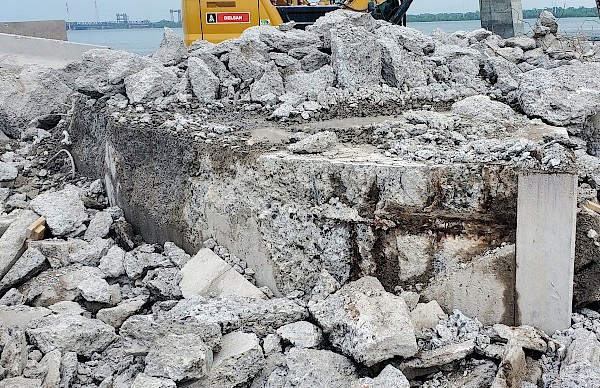
Advanced Techniques for Condition Assessment of the Cham plain Bridge After 57 years of Service
+ Researchers: Leonardo EM. Sanchez and Beatriz Martin-Perez (University of Ottawa)
+ Research body: University of Ottawa
Description
To evaluate the performance of concrete structural components over their expected service ite, effective and reliable tools are required to correlate reductions in the mechanical properties of used materials with structural consequences, For this project, advanced and non-destructive microscopic and mechanical techniques will be used to correlate the type ‘and extent of damage of the affected material with mechanical and durability losses. Automated tools based on machine learning techniques under development will be applied to bridge components to increase the speed and accuracy of diagnosis of the affected structural components.
Goals
Increase the speed and accuracy of diagnosis of the affected structural components.
Results
Components recovered from the original Champlain Bridge were examined to assess deterioration caused by steel corrosion and alkali-silica reaction. Deck slabs, girders, FRP-retrofitted diaphragms, and pier elements were evaluated using advanced non-destructive testing, laboratory investigations, and nonlinear finite element analysis. The study correlated observed damage with structural behaviour and assessed the condition of FRP-concrete interfaces, generating valuable data on the performance, rehabilitation, and long-term management of ageing bridge infrastructure.
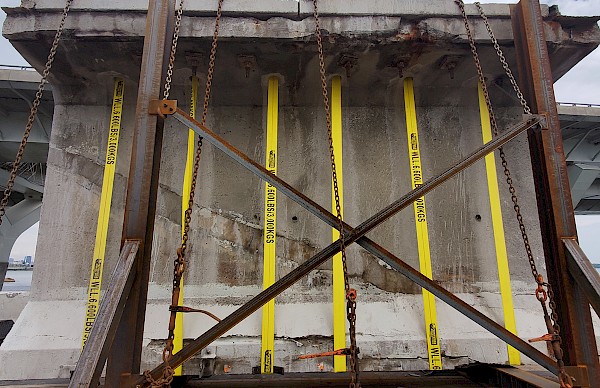
Assessment of Corrosion and Evaluation of the Degree and Distribution of Corrosion on Response of Girders
+ Researchers: Denis Mitchell (Universite McGill)
+ Research body: Universite McGill
Description
Evaluating the performance of prestressed girders that have degraded to due to corrosion is a major issue. Some innovative exterior repair solutions used on the bridge’s prestressed girders will be evaluated to confirm hypotheses.
Goals
Better understand the degradation process of prestressing cables due to external influences, the redistribution of loads between cables, and their performance in different states of degradation.
Results
The project revealed significant corrosion in girder P7 of span 28W-29W and elevated chloride concentrations in the strand grout, with structural impacts varying based on the number of strands lost. Analysis indicates that critical cracking and strength loss thresholds have been reached, although girders P1 and P7 of span 12E-13E exhibited significantly less corrosion at mid-span.
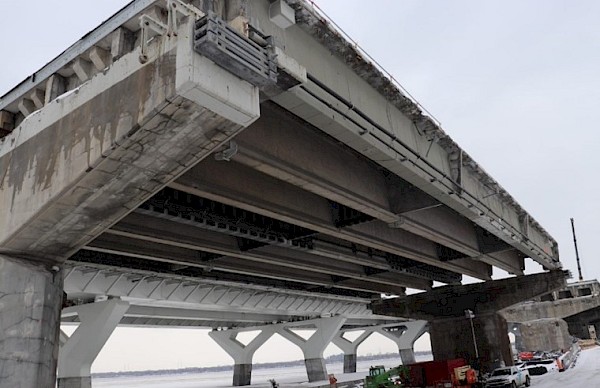
Evaluation of the Residual Bearing Capacity of the Intermediate Slabs and Reinforcement with UHPC
+ Researchers: Jean-Philippe Charron and Mahdi Ben Ftima (Polytechnique Montréal)
+ Research body: Polytechnique Montreal
Description
Conventional tools currently used to assess the residual strength of deck slabs do not take into account the rapid failure of corroded reinforcements. This project will involve new condition assessment techniques and consist of an experimental program using the bridge’s intermediate slabs in a realistic context
Goals
Provide a complete solution that includes a theoretical and actual evaluation of the residual capacity of deck slabs as well as sustainable reinforcement method with the use of ultra-high performance fibre-reinforced concrete (UHPC).
Results
Bending tests showed that UHPFRC repairs significantly outperformed reinforced concrete repairs, reducing crack widths by up to 10 times and increasing ultimate strength by 20% to 100%. Casting methods and reinforcement further enhanced performance. The results confirm UHPFRC as a durable, low-maintenance solution for extending bridge service life and improving infrastructure sustainability.
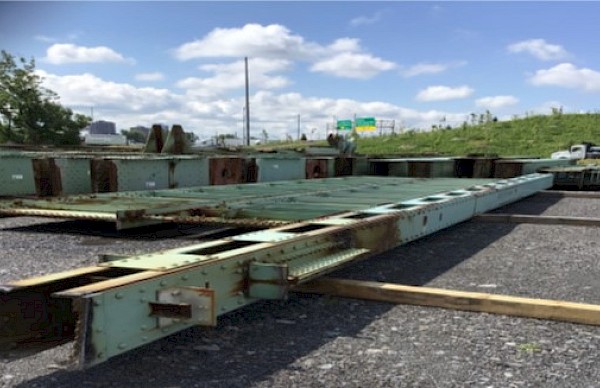
Study of the Compressive Strength of Steel Truss Bridges Made of Assembled Parts
+ Researchers: Robert Tremblay (Polytechnique Montreal) | Nicolas Boissonnade (Université Laval)
+ Researchers body: Polytechnique Montréal
Description
Older major steel truss bridges are made of chords consisting of assembled parts. Current standards do not account for the flexibility and strength of these connecting parts. This project aims to develop calculation methods to evaluate the compressive strength of these chords to determine their flexural and shear rigidity.
Goals
Reduce uncertainty during the evaluation of bearing Capacity to better pinpoint rehabilitation strategies.
Results
Upcoming Results
Other research projects
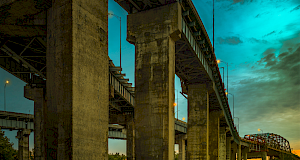
In collaboration with the International Laboratory for Anti‑Icing Materials (LIMA) at Université du Québec à Chicoutimi, PJCCI conducted studies to test potassium formate as an alternative to traditional de‑icing salts.
PJCCI studied the use of new technologies, including drones, as an alternative to traditional diver‑based inspections, in collaboration with the Interdisciplinary Centre for the Development of Ocean Mapping (CIDCO).
PJCCI continues to develop and apply ultra‑high‑performance fibre‑reinforced concrete (UHPFRC) to improve infrastructure durability, including its application on a massive pier of the Honoré‑Mercier Bridge.
Latest news
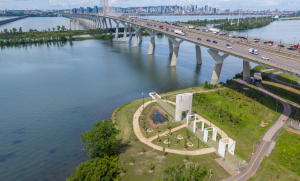
Héritage Champlain Pathway:…
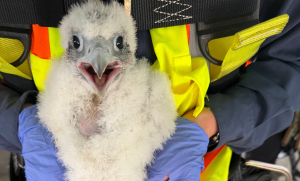
From the nest box to first…