


Period : 2000 - 2014
Would the Champlain Bridge be maintained or replaced?
BackIn 2005, JCCBI commissioned Les Conseillers ADEC Inc. to carry out an economic study comparing the estimated cost of maintaining the bridge with that of replacing it.
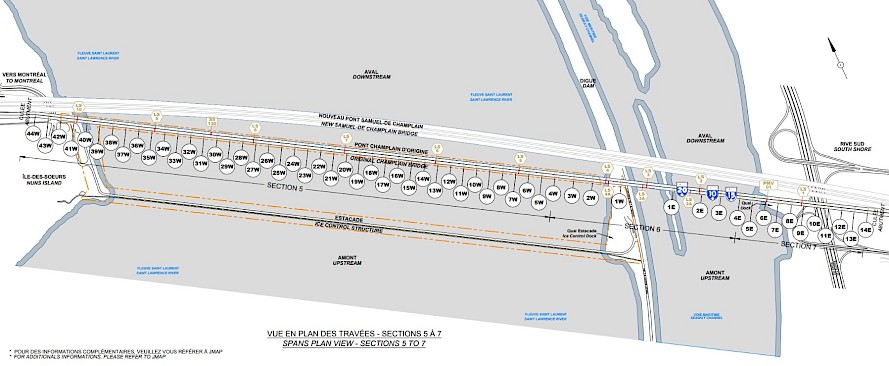
Reference map of the original Champlain Bridge to clearly locate the different sections and piers.
Among other things, the resulting report revealed that maintaining the existing bridge for the next fifty years would prove as costly as maintaining it for fifteen years and then building a new one in 2020. When its work began, ADEC did not expect it would recommend replacing such a major piece of infrastructure after just 53 years of operation.
First girder monitoring instruments
In 2006, two contracts were awarded to TEKNIKA HBA. Using equipment supplied by OSMOS, the firm would undertake the following work:
- Monitoring eight girders and one pier cap after installing the required instruments.
- Using optical probes to assess the response to the installation of three bridge bearings on the west abutment of the Champlain Bridge.
These were the first in a series of contracts for monitoring the bridge’s girders and pier caps. Instruments would continue to be installed, and data would continue to be collected until the original Champlain Bridge was decommissioned in 2019.
Hole discovered in a girder
In 2007, a hole developed in the core of a girder due to concrete delamination along a post-tensioning cable. It was discovered during work to remove the concrete on either side of the core and to repair the edge girder (P7) on Span 26W-27W of Section 5 of the Champlain Bridge.
The detection of this hole was reported by a number of media.

Credit: La Presse
Article: Signes inquiétants de dégradation sur le pont Champlain, September 15, 2008.
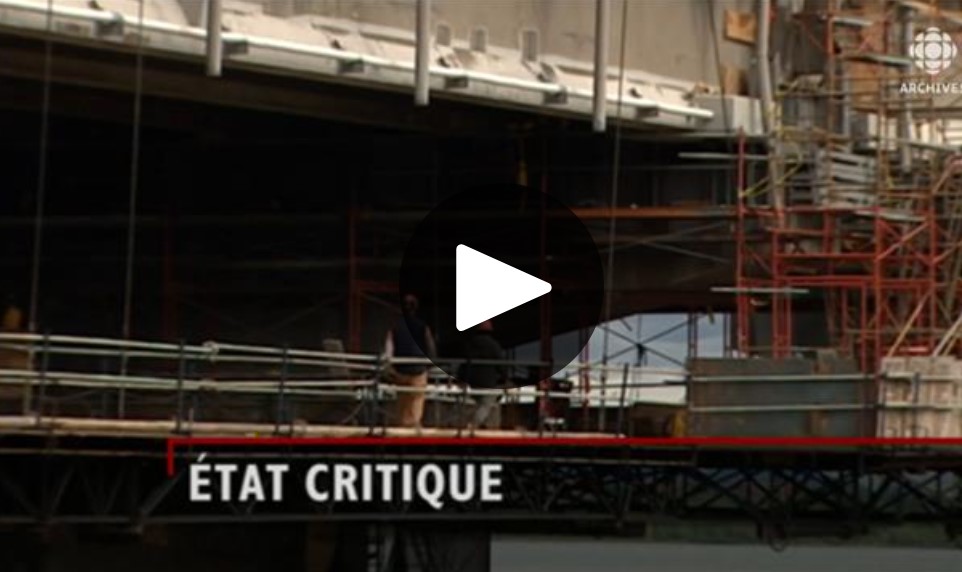
Credit: Radio-canada
Téléjournal/Montréal, September 15, 2008.
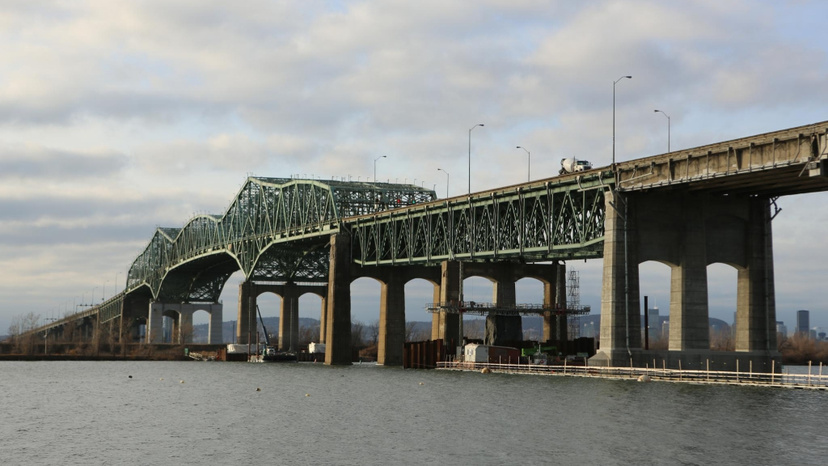
Credit: La Presse
Article: La vérité sur le pont Champlain, September 17, 2008.
The hole was repaired, and the area was reinforced with external steel clamps and subjected to a special monitoring program. Detailed drawings for the reinforcement of the girder in question were prepared by Dessau Soprin Inc. In 2007, the girder was checked by TEKNIKA HBA Inc. using equipment supplied by OSMOS.
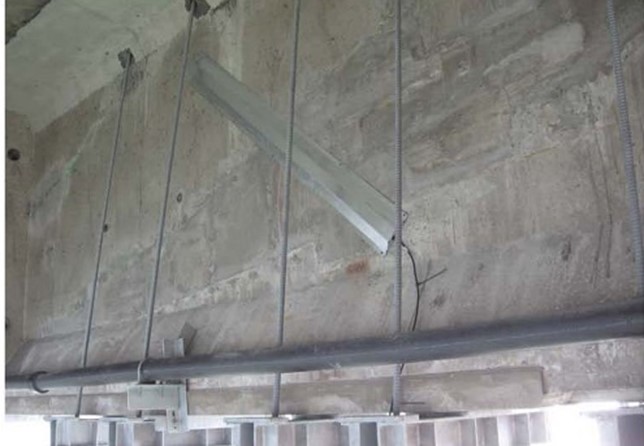
Credit: JCCBI
External clamps and optical gauges, inner side.
That same year, JCCBI commissioned OXAND Canada Inc. to carry out a risk study on the prestressed girders. The work included the preparation of a final report on the risk analysis of a typical span of the bridge.
Queen post truss and superbeam design
In December 2007, Buckland & Taylor Ltd. was awarded a contract to prepare detailed drawings for the installation of a shear reinforcement system for prestressed girders. That same year, the firm carried out preliminary design work on a queen post truss. The detailed design was completed in 2008.
Trucks roll over in high winds
On June 10, 2008. Strong winds toppled trucks, disrupting traffic flow and attracting media attention.
