


Period : 1985 - 1999
Repairs to edge girders and expansion joints
BackIn 1986, the first contract was awarded for edge girder repairs on the original Champlain Bridge. Nine girders were repaired by adding external post-tensioning cables to compensate for the loss of internal post-tensioning.
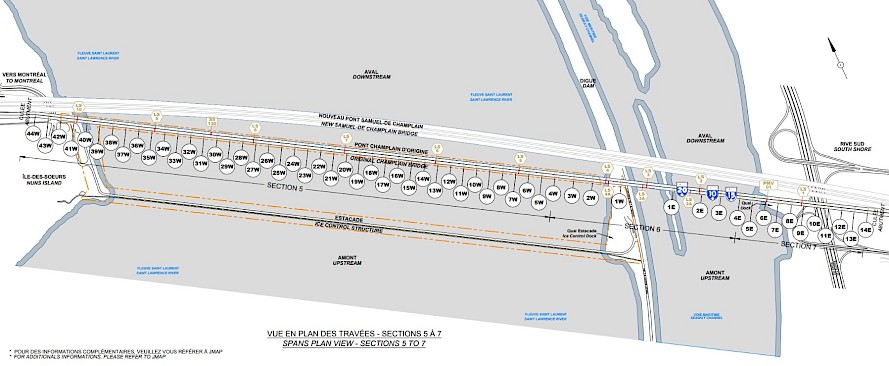
Reference map of the original Champlain Bridge to clearly locate the different sections and piers.
This could be done using a steel anchor block (option A) or a concrete anchor block (option B). In the end, option B was selected.
A report prepared by the SLSA analyzed the use of road salt for de-icing the Jacques Cartier Bridge and the Champlain Bridge. The report had been commissioned after the discovery of significant damage to the lower footings of the prestressed edge girders on the original Champlain Bridge.
It explored the possibility of using de-icing materials other than salt. But ultimately, no alternatives were recommended. Between 1987 and 1989, three contracts were awarded as part of a project to seal all the bridge’s expansion joints—except for those in section 6, which would be addressed when the deck was replaced a few years later.
Expansion joint sealing involved the following work:
- Cutting off the original steel teeth.
- Welding an interlocking system onto the vertical faces of the joints.
- Installing a new rubber joint gasket.

Credit : JCCBI
Area of asphalt wear and asphalt patching in the vicinity of an original expansion joint. Annual inspection report for 1973.
Inspection and replacement of post-tensioning cables on piers 2E and 2W
In 1985, Soudure René Thibault Inc. was awarded a contract to remove the concrete surrounding post-tensioning cables that had been installed on pier 2E in 1964.
This involved the following work:
- Removing damaged concrete.
- Exposing the post-tensioning cables.
- Carrying out a thorough inspection of steel components.
- Enclosing the post-tensioning cables in a sheath.
Similar work had already been carried out on pier 2W. According to a missive from H.H.L. Pratley, the post-tensioning cables on pier 2E had initially been installed in the summer of 1964 and covered with concrete in August of the same year. However, the ones installed on pier 2W had been exposed for an entire winter before being covered.
Addition of post-tensioning cables on girders
The post-tensioning cables installed on piers 2E and 2W about two years after the bridge opened were replaced. Also in 1985, the SLSA produced a special report on the condition of the edge girders in sections 5 and 7 of the bridge. In August, pieces of concrete fell onto the bike path under an approach girder at the South Shore end of the bridge (8E-9E).
An inspection found that seven of the 22 post-tensioning cables were so corroded at mid span that they could not be taken into account when assessing the girder’s load-carrying capacity.
Replacement of the central divider and outer guard rails, and sealing of joints
During these years, the central divider was replaced on all of the bridge’s approaches (work had begun in 1987), and the expansion joints were sealed (the last of three contracts was completed in 1989). Also, in 1994 and 1995, changes were made to the drainage system and the outer guard rails were replaced with Jersey barriers made from precast concrete.
The sealing of the expansion joints, the changes to the drainage system and the replacement of the outer guard rails were key to extending the life of the bridge, which had opened to traffic 33 years earlier. They were replaced after years of exposure to de-icing salt.
In 1988, COREXCO was awarded a contract to design, supply and oversee the operation of a facility for testing a cathodic projection system. This pilot project was intended to explore ways of limiting corrosion damage to the bridge’s prestressed girders.

Credit: JCCBI
Image above: section of the original finger type expansion joint. Images below: shows how the steel fingers were cut, a new seal clamping component welded to the original joint allowing the installation of a rubber seal to close the joints.
