


Period : 1970 - 1984
Major rehabilitation work
BackBetween 1975 and 1979, major maintenance had to be carried out on the original Champlain Bridge, in response to signs of advanced wear on the deck and major structural deficiencies.
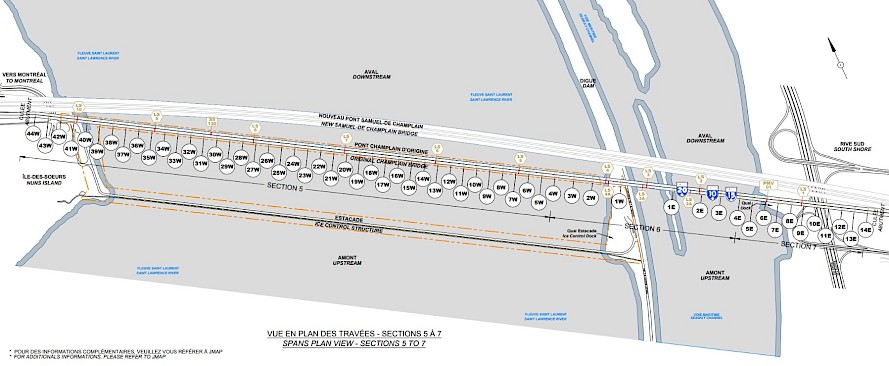
Reference map of the original Champlain Bridge to clearly locate the different sections and piers.
The annual inspection report for 1975 found that the asphalt in section 5 of the bridge was showing signs of advanced wear. Furthermore, holes between 2 inches and 3 inches deep had been found in the concrete slab. National Harbours Board – Port of Montreal was awarded the contract to carry out the rehabilitation work.
Towards the South Shore, between piers 2W and 4W, the entire deck surface (a width of 37 feet) was covered with about an inch of asphalt. Originally, section 6 between piers 4W and 4E had been an exposed concrete slab, without an asphalt surface.
Towards Montreal, between piers 2W and 4W, a width of just over two lanes (26 feet and 6 inches) was covered with about an inch of asphalt. The remainder of the deck consisted of an exposed concrete slab.
The concrete covering (approx. 1.5 inches thick) over the top layer of steel reinforcement had to be removed by scarifying and replaced by a new layer of concrete approximately 1.5 inches thick.
The inspection report for 1976 noted that the asphalt on the approach spans, in sections 5 and 7, had been completely replaced. During this work, areas where the concrete slab had disintegrated were repaired, and the asphalt was completely scarified and resurfaced.
In 1978, the condition of the exposed concrete deck slab on the Champlain Bridge between piers 4 E and 4W was assessed. That portion of the concrete slab under lane 6, between piers 2W and 4W, was resurfaced using the Iowa Method.
Iowa Method: Remove the top 50 mm of the deck to expose the steel reinforcement and recover it with concrete.
In 1979, the remaining surface of the concrete slab was also replaced using the same method.
Construction of a temporary bridge
Also in 1978, 16 years after the opening of the bridge, the St. Lawrence Seaway Administration (SLSA) had to issue a major contract. The upper parts of abutments 44W and 14E needed to be replaced due to major structural deficiencies.
During the work, a temporary bridge was erected to allow for the upper part of the abutments (the backwalls) to be rebuilt. The work also involved building transition slabs and repaving around these abutments.
An underwater inspection of piers 18W, 21W, 23W, 24W, 25W, 26W, 30W and 32W on the original Champlain Bridge was also carried out by Montreal Underwater Service Inc.
Credit: JCCBI
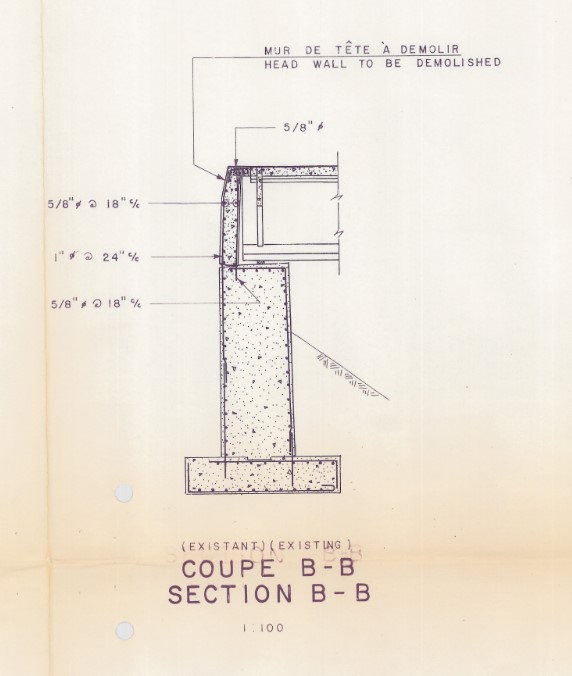
Backwall of the original abutment.

Credit: JCCBI
Plans for new backwall and transition slab.

Credit: JCCBI
Temporary bridge required to maintain traffic flow while work was being carried out.
