


Period : 2000 - 2014
In-situ stress measurements on selected girders
BackTecsult Inc. was awarded a contract to analyze the true stress values calculated for the bridge’s prestressed concrete girders. The testing carried out in 2004 involved an innovative technique used for the first time on the girders of the Champlain Bridge.
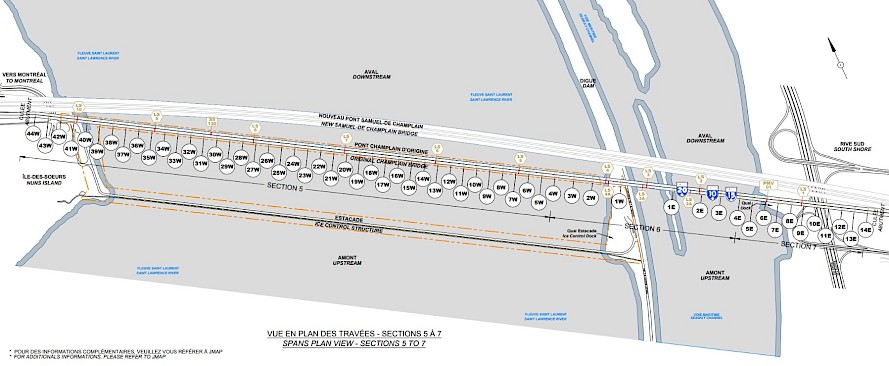
Reference map of the original Champlain Bridge to clearly locate the different sections and piers.
In short, the technique involved installing a small steel frame fitted with extensometers to measure the deformations that occurred when an opening was cut in the concrete core of a girder using a concrete chainsaw.
Then, a flat hydraulic jack was inserted into the opening, exerting pressure on the sides and reversing the deformations. The true stress values for the concrete girders were calculated based on the hydraulic pressure required to perform this operation.

Credit: JCCBI
Flat hydraulic jack inserted into the opening, surrounded by a frame fitted with instruments.
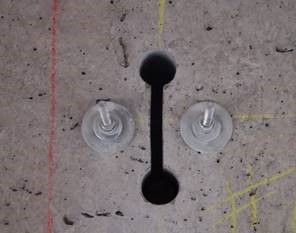
Credit: JCCBI
The opening made by a concrete chainsaw and the bolts used to attach the frame.
Laser scanning of the steel span in Section 6
In 2005, SCDS Pro was awarded a contract to carry out summer and winter LiDAR surveys (3D laser imaging). The aim was to conduct a general assessment of the main span’s thermal performance. This work made it possible to produce a highly accurate 3D digital model of the structure.
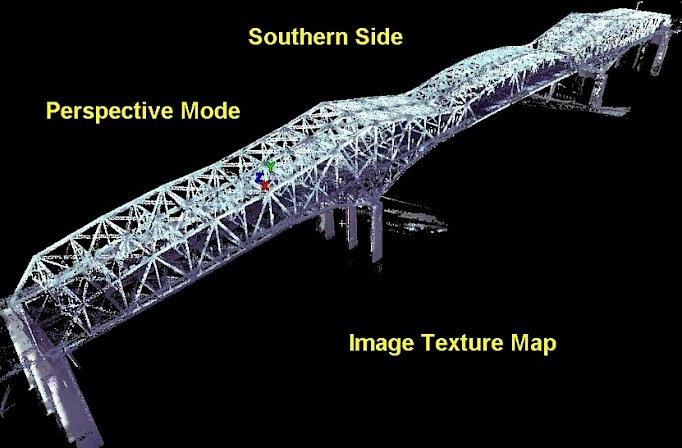
Credit: JCCBI
3D LiDAR-generaded point cloud for the entire bridge.
