


Period : 2000 - 2014
Champlain Bridge replacement announced
BackIn March 2011, the BCDE consortium (BPR/CIMA/DESSAU/EGIS) submitted the detailed results of its pre-feasibility study on the replacement of the original Champlain Bridge. That same month, DELCAN submitted its condition assessment of Sections 5, 6 and 7 of the bridge. On October 5 of the same year, the Government of Canada announced that the Champlain Bridge would be replaced by a new bridge.
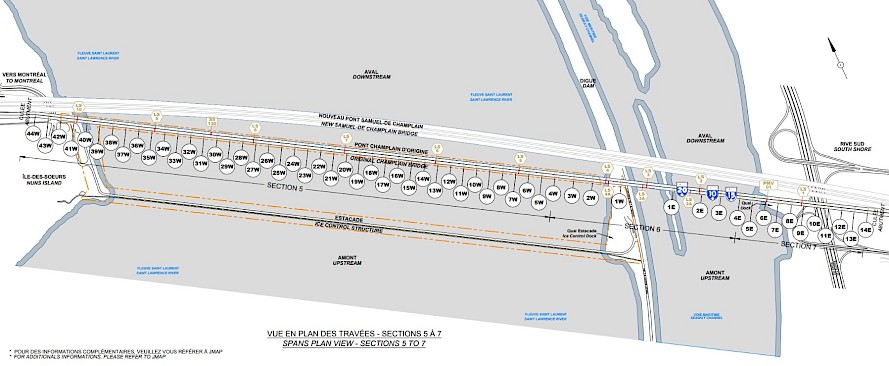
Reference map of the original Champlain Bridge to clearly locate the different sections and piers.
An innovative approach to strengthening a girder and supporting the deck
In 2011, Les Consultants AECOM Inc. was awarded a contract to study rehabilitation of the deck, piers and prestressed girders on Sections 5 and 7 of the Champlain Bridge. The firm also produced the associated drawings and specifications.
Over the course of the contract, which ran from 2011 to 2013, the firm developed two innovative reinforcement methods:
- The first method involved reinforcing a girder using deviated strands. It could be used in place of a queen post truss, in locations where there was limited clearance under a girder.
- The second method involved repairing and reinforcing the deck in response to the deterioration of the transverse post-tensioning in the deck slab.

Credit: JCCBI
Steel structure of the original Champlain Bridge.
These systems were first installed in 2013 by Pomerleau Inc., as part of a contract to rehabilitate piers, pier caps, girders and deck joints on Sections 4, 5 and 6.
Edge girder reinforcement technology
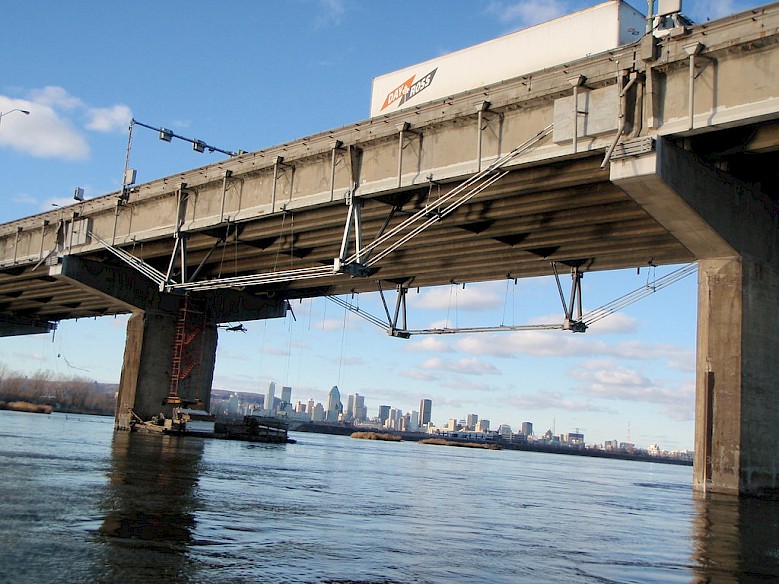
Between 2012 and 2013, two queen post trusses (Queen Posts 1 and 2) were installed as reinforcement. They compensated for loss of ductility and improved shear strength on 40 edge girders of the original Champlain Bridge.
This particular girder reinforcement technique offered several benefits:
- Improved shear capacity.
- Compensation for loss of ductility.
- Ease of fabrication and installation.
- No impact on traffic.
Credit: JCCBI
Queen post trusses.
Monitoring with sensors and controllers
Between 2012 and 2015, a responsive approach was taken to implementing and updating a monitoring program for the original Champlain Bridge. The aim was to closely track the bridge’s behaviour by recording a set of indicators that would warn of any events requiring a response.
The monitoring system consisted of sensors and controllers. It recorded dynamic events associated with bridge traffic, making it possible to track three factors:
- The number of events.
- Deformation measurements.
- The girders’ natural frequencies.
Monthly load tests were also carried out using a 30-ton truck, to assess the condition of the edge girders. The Champlain Bridge monitoring program implemented by JCCBI made it possible to arrive at a fairly precise assessment of the structure’s condition, all while adjusting rehabilitation and reinforcement efforts based on signs of deterioration.
Credit: The Gazette, March, 2016
Report on load tests, produced with Dominic Lavigne, Senior Monitoring Engineer at JCCBI.
