


Period : 1985 - 1999
Aftermath of the 1998 ice storm
BackBy Friday, January 9, 1998, the Island of Montreal had received 100 millimetres of freezing rain in the span of just five days. Most of the region was left without power. Authorities decided to close the bridges to the South Shore for four days as a safety precaution. Emergency de-icing operations also needed to be carried out.
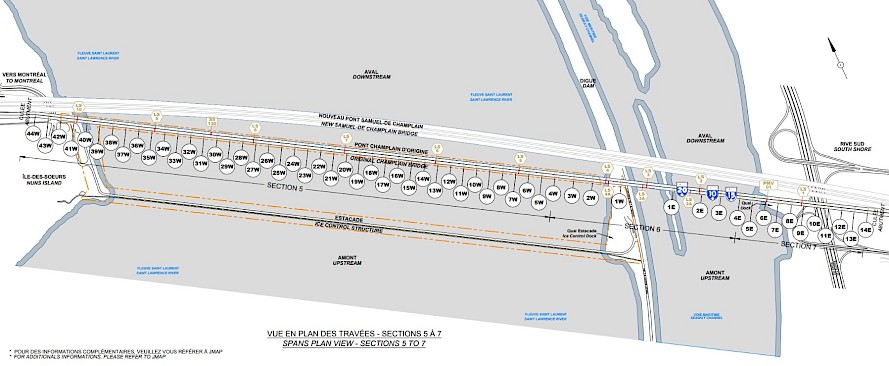
Reference map of the original Champlain Bridge to clearly locate the different sections and piers.
For many long hours, the bridges were completely deserted. JCCBI was assisted in its emergency response by its consultants: BBL Inc. and SNC-Lavalin Inc.
An innovative approach to ice removal
Glen Carlin, JCCBI’s CEO at the time, came up with an ingenious way of removing the ice that had built up on the bridge. He proposed placing a vibrating plate, the kind normally used to compact soil, directly on the structure. The vibrations broke off the ice from the bridge structure. It proved to be an effective solution that was applied to the structure one member at a time.
Soldiers and firefighters soon arrived to lend a hand. They set about removing the remaining ice from the upper sections of the Jacques Cartier Bridge.
This innovative approach made it possible to de-ice the bridge quickly and safely, despite difficult weather conditions, a lack of electricity, and shortages of materials, equipment and labour.
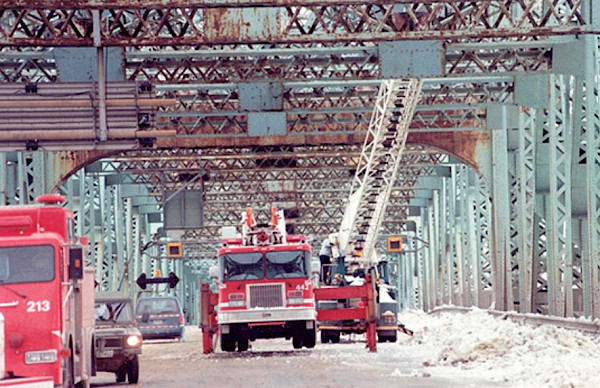
Credit: JCCBI
Firefighters who came to assist took over on the raised sections of the Jacques Cartier Bridge to remove what remained of the ice.
Weakened span on the Champlain Bridge
In 1999, a report produced by Buckland and Taylor Ltd analyzed the three-dimensional failure of a prestressed concrete beam.
The report indicated that there may be a long-term risk of progressive weakening of an entire span associated with the ongoing deterioration of the prefabricated edge girders.
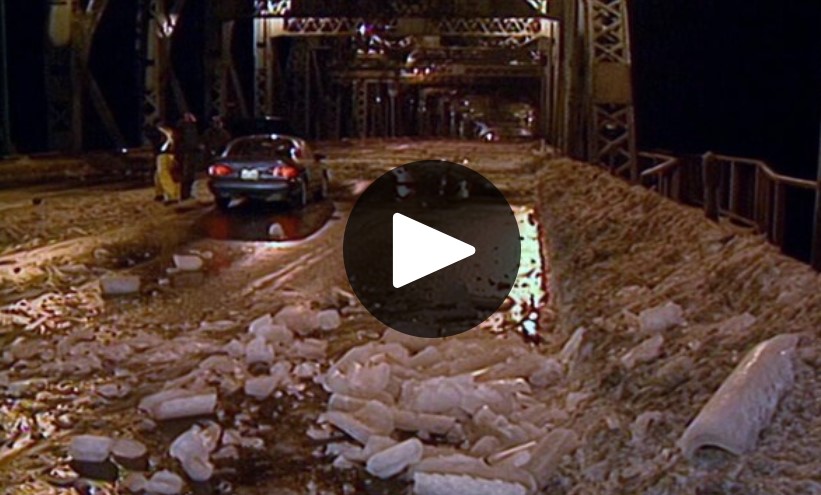
Credit: Radio-Canada
Crise du verglas : 20 ans plus tard. Radio-Canada report with Mr. Glen P. Carlin, CEO at JCCBI in 2018.
