


Period : 2015 - 2025
Operation of lowering the main span
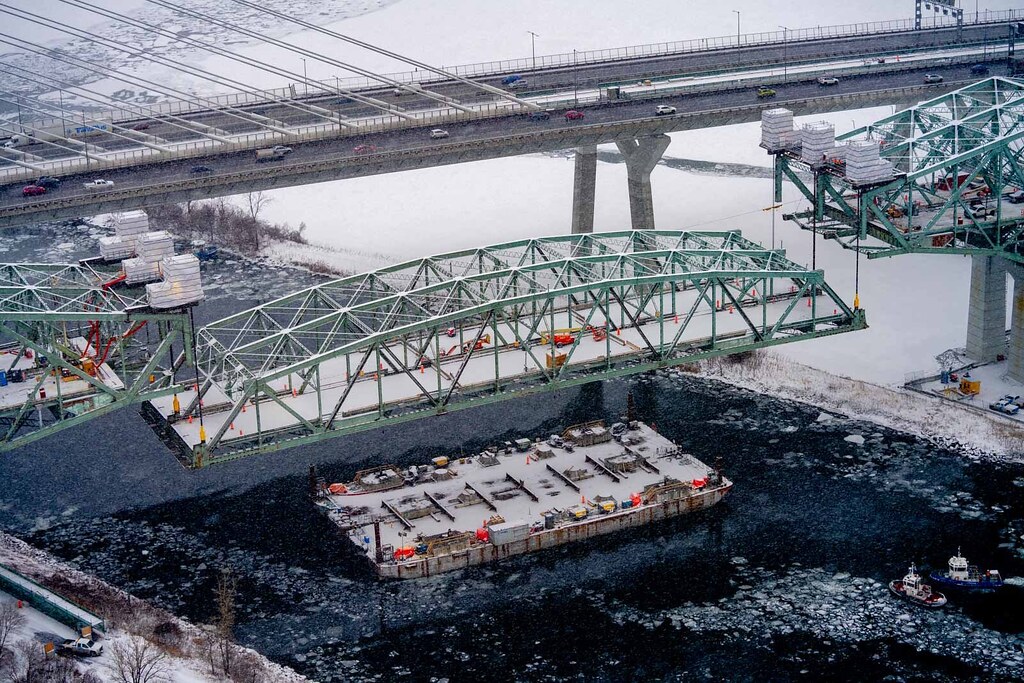
BackOn January 6, 7 and 8, 2022, NHSL and its expert suppliers from Europe, the United States and Ontario were ready to begin the operation of lowering the main span of the original Champlain Bridge.
This delicate operation was the result of nearly two years of detailed design, coordination and planning. Taking down a suspended span under changing winter conditions, the lowering of the suspended span took 17 hours of continuous work and was a major engineering achievement but also a Canadian first!
 Credit: JCCBI
Delicate operation of lowering the main span.
This 2,200-tonne span was removed and lowered onto a two-barge assembly using six strand jacks installed on temporary support girders. Heated enclosures surrounded the strand jacks to protect them from the wind and keep them functional.

Credit: JCCBI
Example of one of six strand jacks installed on temporary support beams.
Stages of the descent:
- Cutting the span.
- Lowering the span to a height of 33 meters using six cable jacks on a barge.
- Transfer the loads and weld supports to the barge to solidify this span.
- Turn the span 90 degrees using cables pulled by two tugboats.
- Transport the span across the St. Lawrence Seaway to the temporary storage site, where it was dismantled in spring 2022.

Credit: JCCBI
Descent of the span.

Credit: JCCBI
Transferring loads and turning the span 90 degrees onto a barge.
New condos for cliff swallows
By spring 2022, JCCBI installed 14 cliff swallow girders, capable of housing 40 nests, under the Estacade to compensate for habitat loss.
A large colony of cliff swallows was present around the original Champlain Bridge. JCCBI environmental teams had identified more than 500 nests under the old structure during the targeted environmental assessment.

Credit: JCCBI
Cliff swallows’ nest.
Dismantling of the main span
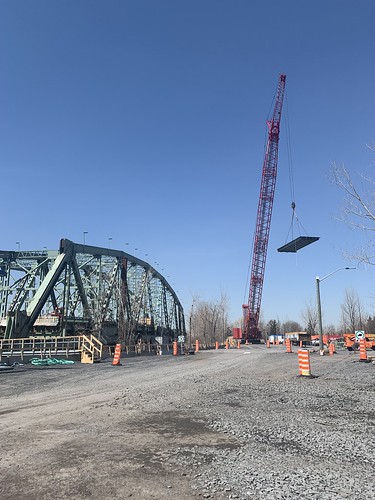
In March 2022, NHSL began dismantling the main span at the St. Lawrence Seaway Management Corporation’s wharf in Brossard. This operation was completed in June 2022.
The structure was dismantled piece by piece with a crane and cutting activities on the ground were also carried out for some sections.
The materials were then transported to specialized recycling centers or taken to a storage site for components intended for reuse.
Credit: JCCBI
Dismantling the main span.
Work in cantilever sections
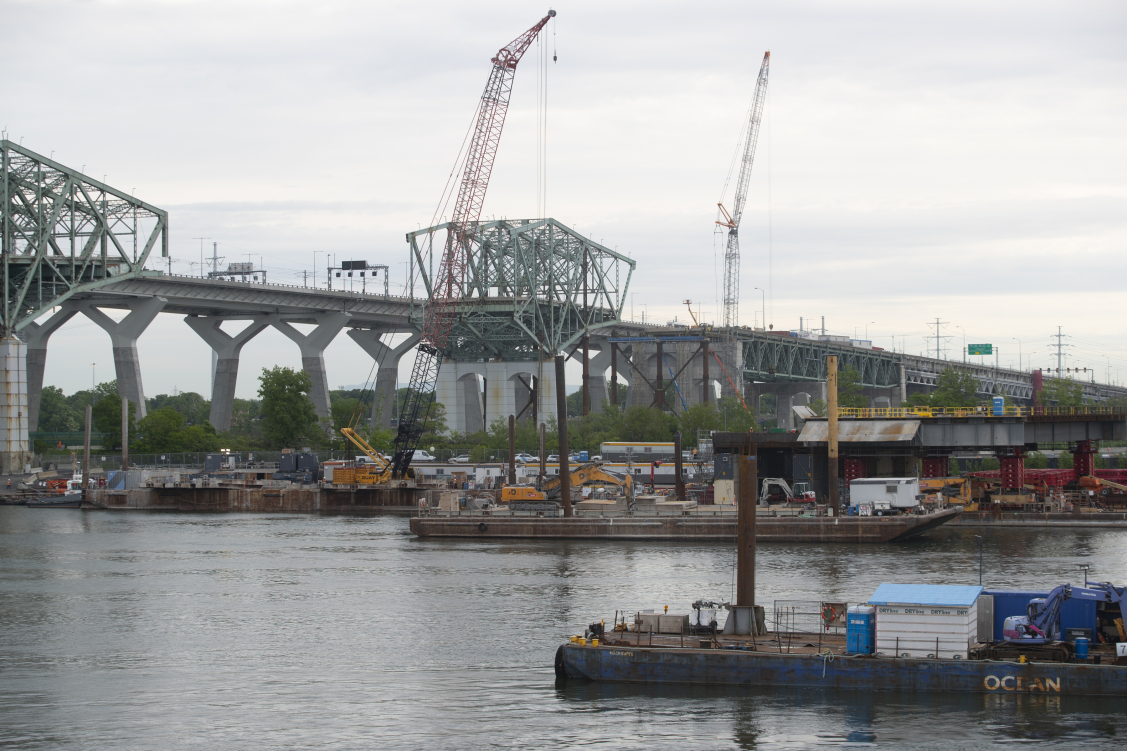
In April 2022, approximately 5,000 tonnes of steel were deconstructed in the cantilever section of the eastern span of the bridge on the Brossard side.

Credit: JCCBI
Lifting operation activity.
Steel reinforcements and two temporary support systems were installed above and below the existing structure. This equipment enabled the structure to be cut into two sections and deconstructed from the center out towards the piers.
Credit: JCCBI
Cantilever section of the original Champlain Bridge.
The five steps of a lifting operation:
- Engineers identify and evaluate the weight of the component to be lifted.
- Once the weight is known, the cutting lines are marked on the component with paint.
- The component is then attached to the crane, and teams on the bridge deck cut the steel pieces.
- Finally, the component is lowered onto the jetty by the crane.
- The materials are sent to authorized recycling sites.
Removal of the 30th and last marine span
On May 13, 2022, a major project milestone was reached with the removal of the 30th and last marine span using the catamaran barge. This custom-built mega catamaran barge, also known as the “River Giant,” lifted and deconstructed the spans in the marine sector while protecting the St. Lawrence River.

Credit: JCCBI
Removal of the 30th and last span.
Removal of modular trusses above Hwy. 132 in Brossard
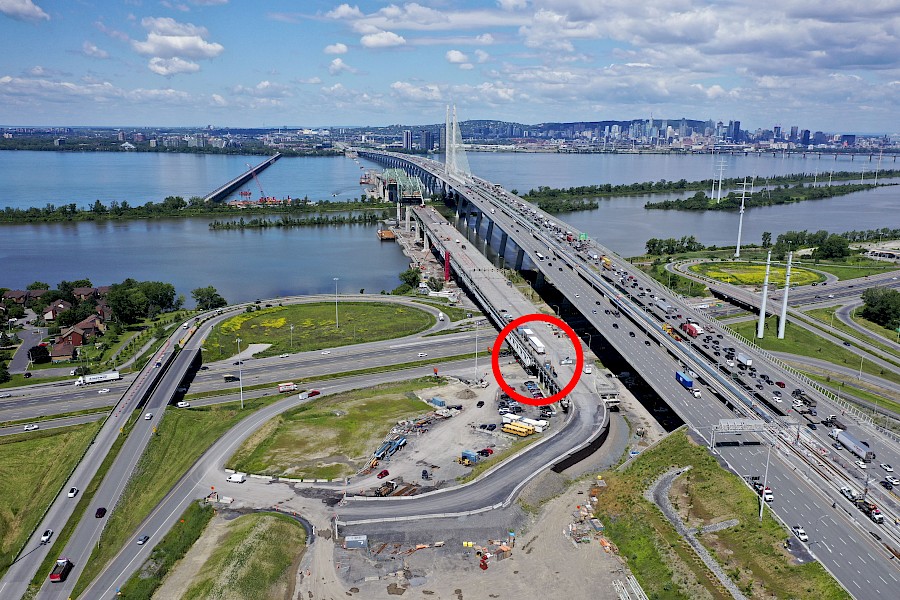
From September to October 2022, three work blitzes took place in the Hwy. 132 in Brossard. This operation was a key stage of the project, as NHSL began removing the modular trusses above Hwy. 132.
In order to minimize the risks and impacts on traffic in this area, NHSL has developed deconstruction methods and sequences to maximize operations in the shortest amount of time.
The work began with the removal of eight modular trusses. These were removed and placed on the ground by two cranes. The trusses were then disassembled and removed by truck for reuse.
Credit: JCCBI
Removal of modular trusses above the Hwy. 132 in Brossard.

Credit: JCCBI
Removal of a modular truss using cranes.
Deconstruction of spans and piers in the Hwy. 132 sector
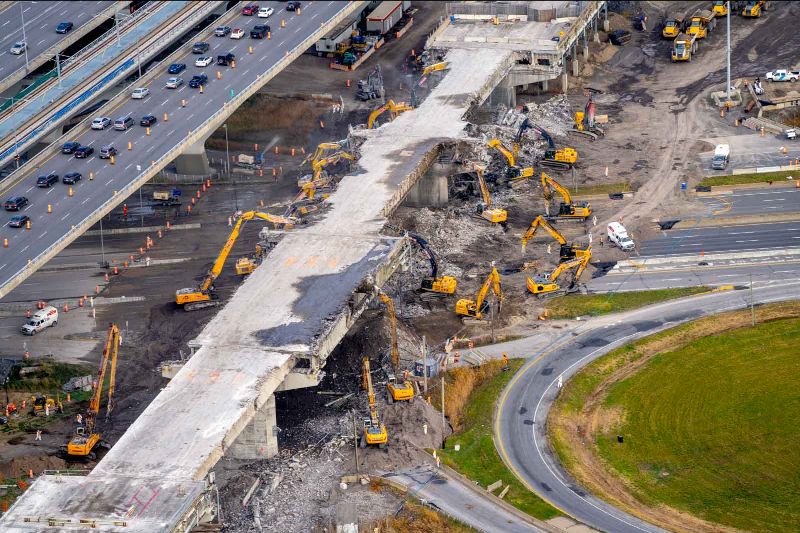
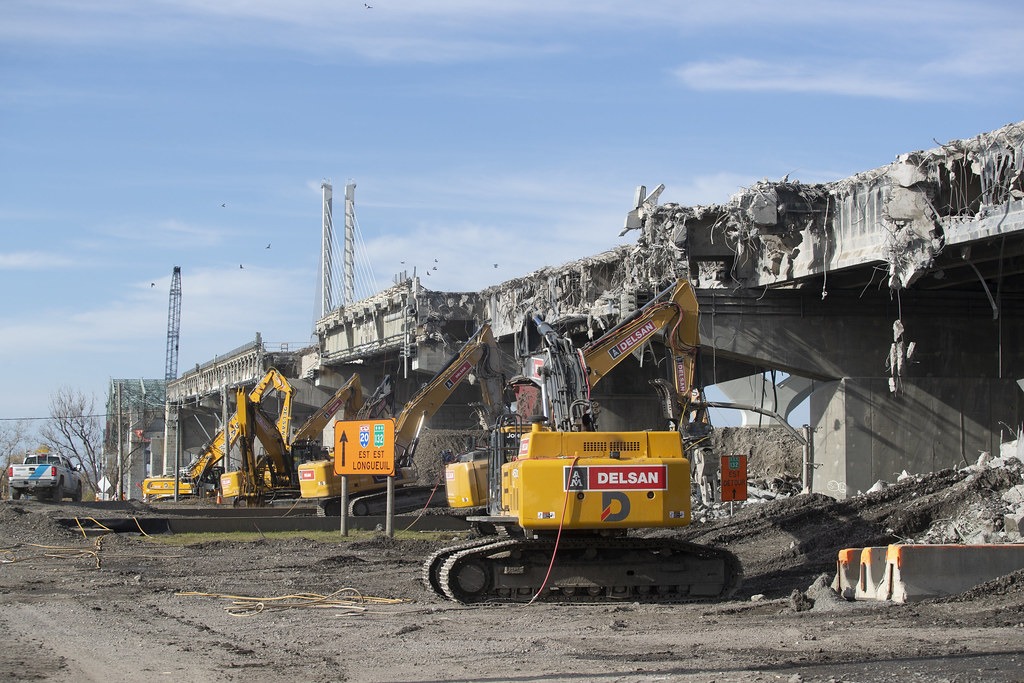
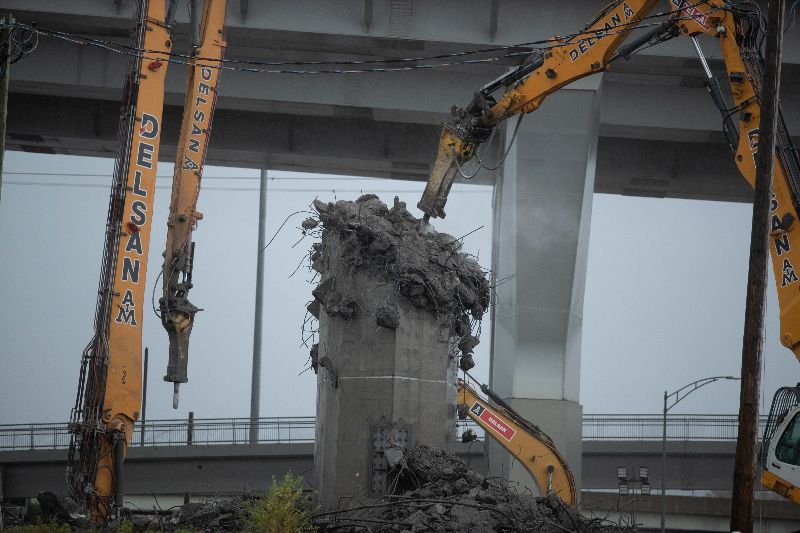
Between November 4 and 7, 2022, 50 hours of work were required to complete the final blitz. This blitz enabled the demolition of four spans and three piers using 18 excavators. Prior to the start of the work, granular cushions made of stone fill recovered from the site were installed to protect the traffic lanes.
Credit: JCCBI
Mechanical demolition of girders, spans and piers, requiring 18 excavators.
Credit: JCCBI
Mechanical demolition of a grider.
Two working methods were required to demolish the spans and the seven girders under the spans:
- A mechanical deconstruction blitz with special-purpose excavators.
- A “controlled” descent for three of the seven remaining girders in the middle of the span.
A number of 3D models were needed to accurately determine the sequence of the “controlled” descent and to safely execute the operation at all times. The work generated nearly 10,000 tonnes of material, which were removed and transported to specialized centres for recycling.
Credit: JCCBI
Demolition of a pier with special-purpose excavators.
Sustainable Development Road Engineering Award
On January 18, 2023, JCCBI and NHSL won the Sustainable Development Road Engineering Award from the Association des constructeurs de routes et grands travaux du Québec (ACRGTQ), which recognizes the excellence of innovative practices by contractors with regard to environmental protection and the preservation of natural resources from a sustainable development perspective.
Time-lapse video of 12 months of work
In February 2023, JCCBI released a time-lapse video of all the work carried out between November 2021 and November 2022.
Credit: JCCBI
Time-lapse video of 12 months of work (November 2021 to November 2022).
