


Period : 2015 - 2025
Maritime work begins above the St. Lawrence River
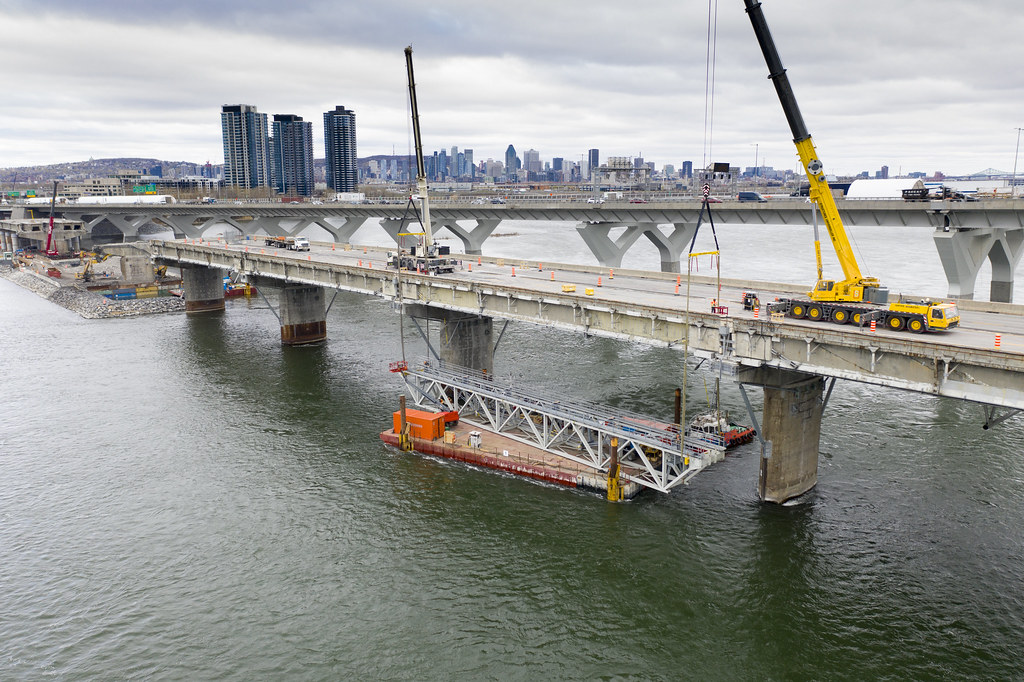
BackIn spring 2021, marine works began with the removal of the 50 modular steel trusses weighing 56,000 kg using cranes on the bridge deck and barges.
Subsequently, NHSL began the deconstruction of the 30 spans with the river giant. Alongside the removal of the spans, the deconstruction of the piers (the legs of the bridge) and the footings (the feet of the bridge underwater) began.
A total of 12 barges were required to perform different tasks and functions to deconstruct the original Champlain Bridge. Each of these barges was assembled using different caissons fitted into each other to create the required shape depending on the work the barge had to carry out.
Credit: JCCBI
Removal of a modular truss using cranes on the bridge deck and barges.
A mission for each barge
Pier deconstruction
Two side-by-side barges measuring 210 feet by 144 feet accommodated the machinery.

Credit: JCCBI
Lifting a span using the river giant.
Footing deconstruction
Two barges assembled into a “C” shape were used to surround the footings which were confined with sheet piles.
 Credit: JCCBI
Removal of a span with the river giant.
Concrete removal
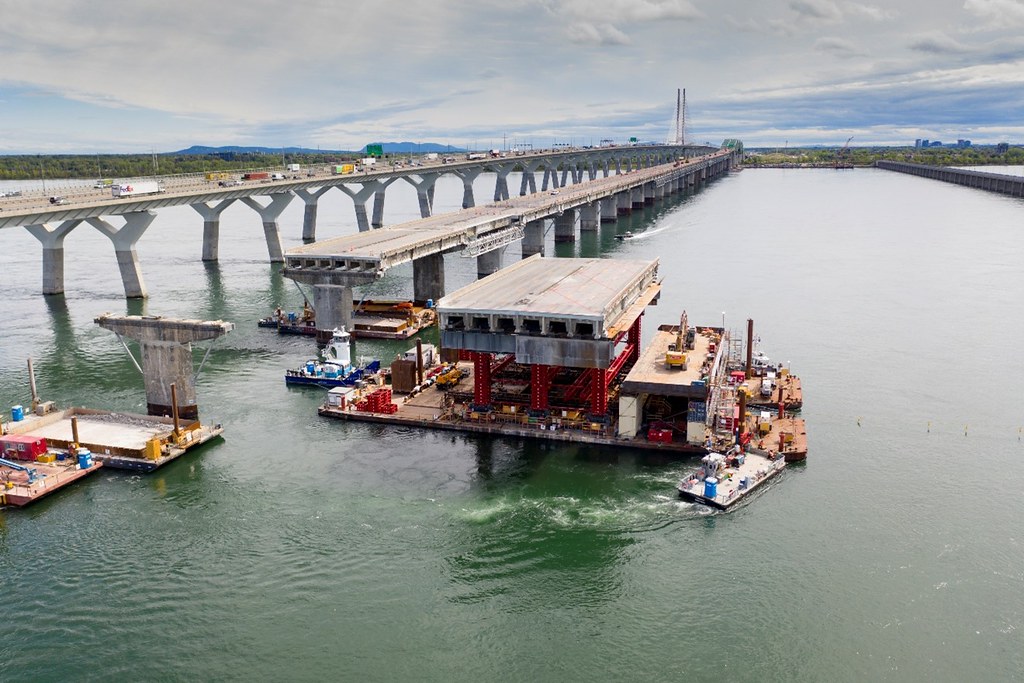
Three rectangular-shaped barges were dedicated to remove the concrete and to help position the river giant under the span to be deconstructed. Two winches were attached to each of these barges to help pull the catamaran barge into position—within an accuracy of ±15 cm—in the strong current of four to six knots.
 Credit: JCCBI
Deconstruction of a span over the river.
Credit: JCCBI
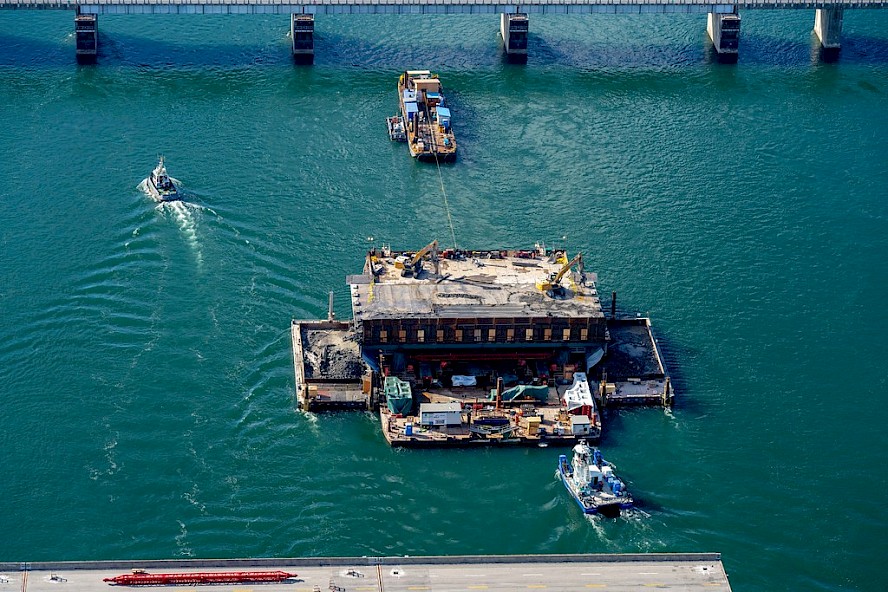
A span being transported on the river.
Innovation Award from the Association des constructeurs de routes et grands travaux du Québec
On May 7, NHSL received the Innovation Award from the Association des constructeurs de routes et grands travaux du Québec (ACRGTQ) for the design of a tool linked in real time to schedule data and which made it possible to share the sequences of upcoming work in a visual, simple and efficient manner.
This tool also made it possible to make complex and changing information on work planning accessible at all times to a large number of stakeholders and ultimately facilitate its execution.
Deconstruction of piers and footings
By fall 2021, a new phase of bridge deconstruction began, requiring a new deconstruction method. Crews began work to remove the bridge piers and the underwater footings.
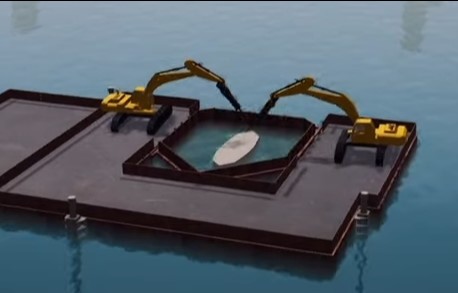
This operation was carried out with specialized excavators on barges which served as a work surface for crews to remove concrete debris toward the Île des Sœurs jetty.
Credit: JCCBI
Specialized excavators on barges.
Deconstruction of the piers
The piers were deconstructed from top to bottom using hydraulic percussion hammers installed on the excavators. The work barges were grouped together to ensure that all deconstruction debris was recovered without impacting the environment and subsequently reused in the materials recycling process.
The two barges used for the piers were 210 feet by 144 feet.

Credit: JCCBI
Removal of concrete debris to the Île des Soeurs jetty.
Removal of the pier footings
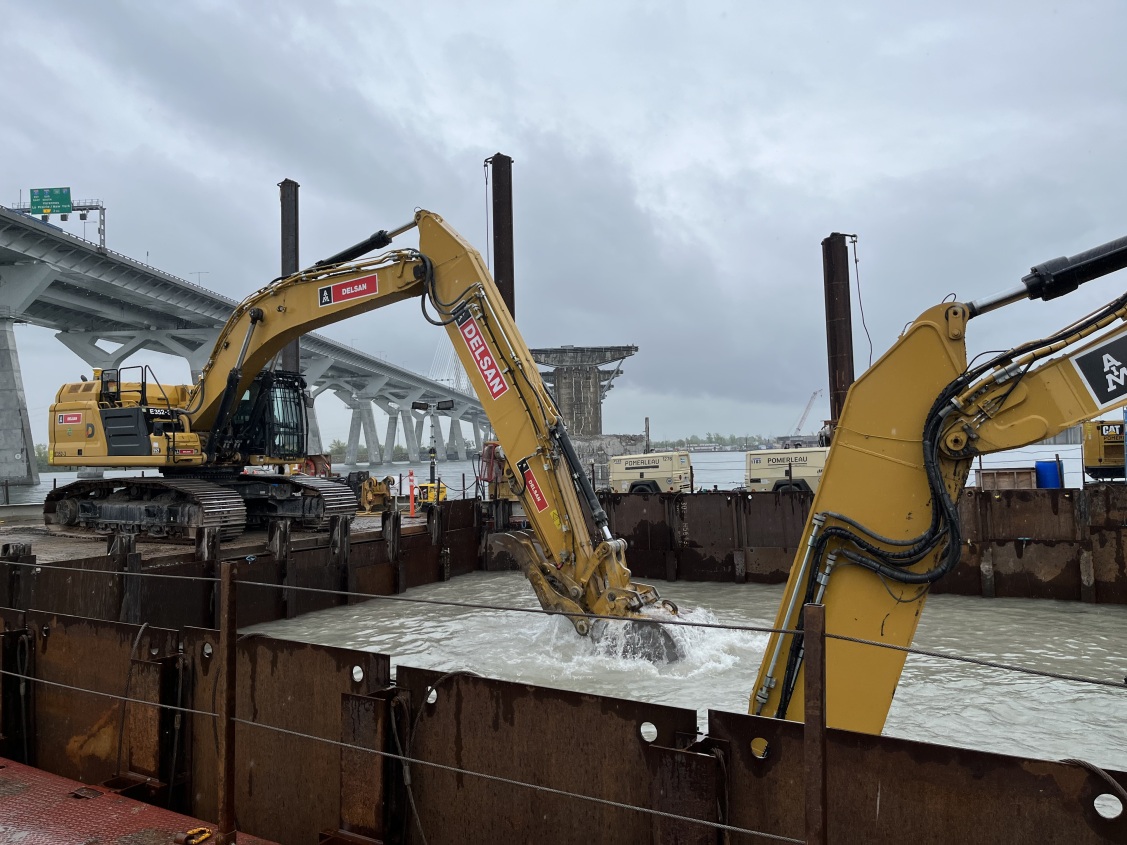
To remove the footings, two barges assembled into a “C” shape were used to surround the footings, which were then confined with sheet piles. Once the sheet piles were in place, excavators with GPS positioning systems extracted the footings from the bed of the St. Lawrence River. Once deconstruction was complete, the empty space left by the footing at seabed level was reconstituted with stone fill, and the confinement was removed.
 Credit: JCCBI
Deconstruction of the footings located under the river.
Steel structure reinforcement work
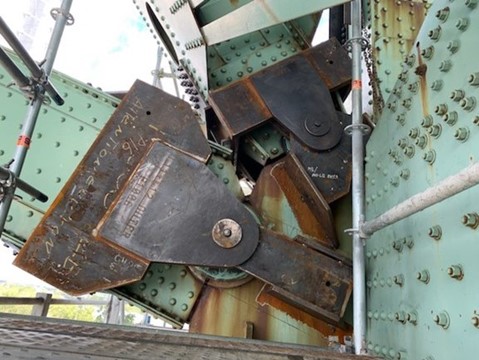
In October 2021, preparatory work to strengthen the steel structure was carried out to properly plan the delicate and spectacular operation of lowering the suspended span over the St. Lawrence River Seaway.
This work consisted of installing specialized support devices necessary for the descent in addition to ensuring the stability of the steel section during deconstruction.
Credit: JCCBI
Special purpose bearings.
Material traceability system
JCCBI and NHSL were committed to effectively and transparently handling the deconstruction materials to ensure that the entire project was managed from a sustainable development approach.
To this end, a materials traceability program has been put in place to ensure real-time monitoring of materials to be managed off-site, which has been recovered.
Credit: JCCBI
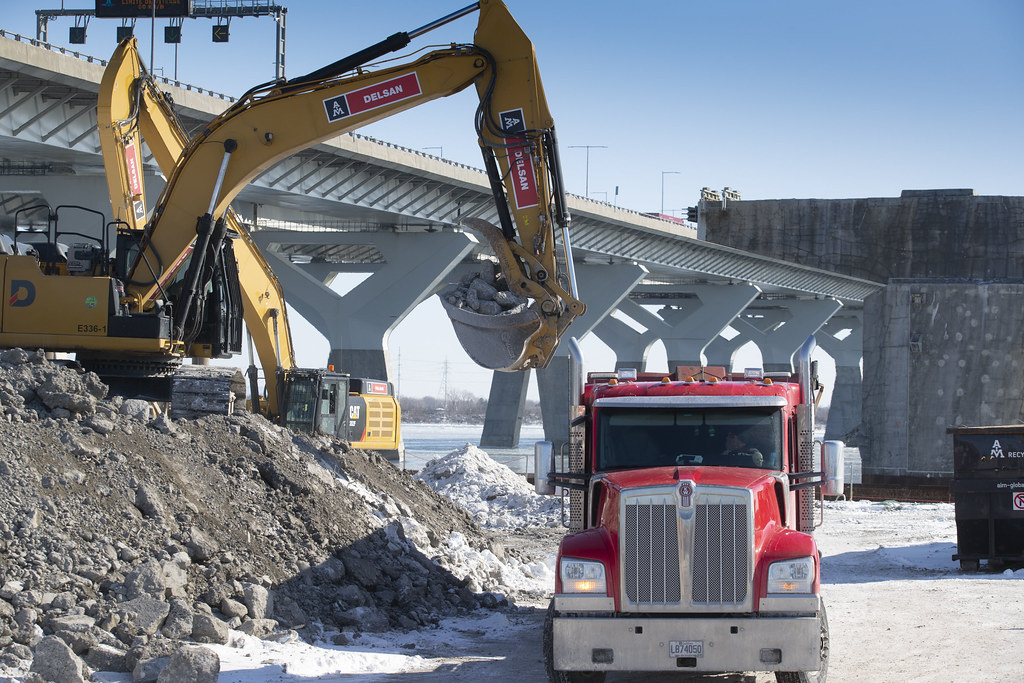
Concrete being dumped into trucks.
Material transportation steps:
- The main leftover materials from the original Champlain Bridge deconstruction project were concrete and steel.
- These materials were separated directly at the site and transported to authorized recycling centres.
- They were transported with trucks that were tracked with a GPS system.
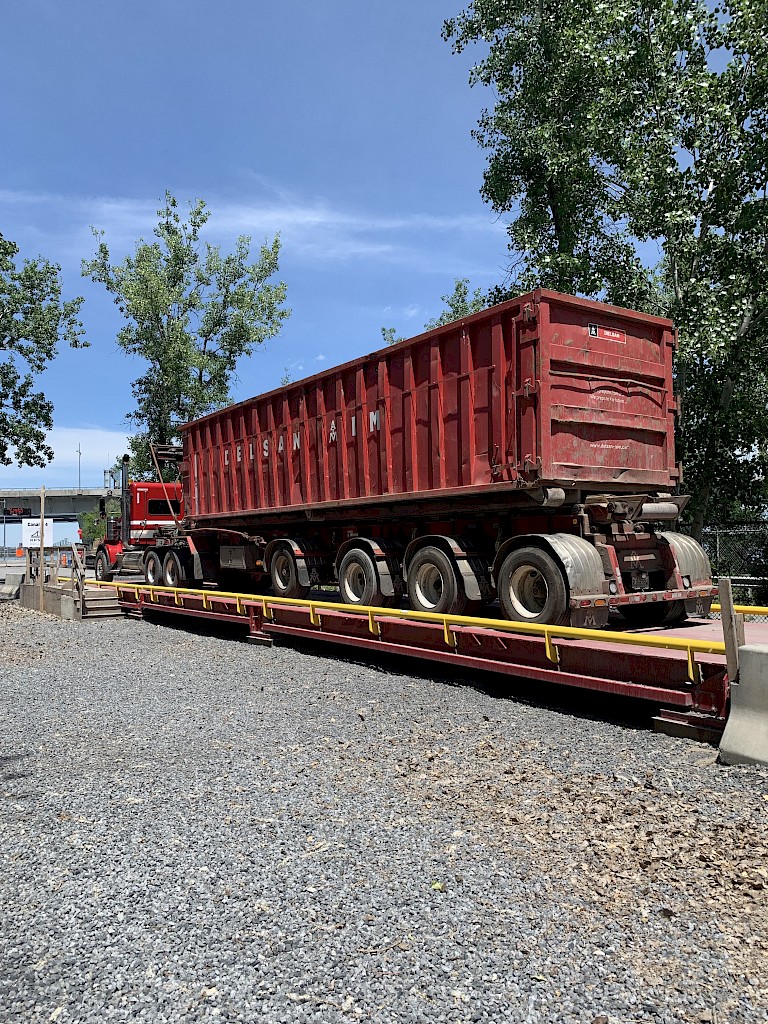
- All trucks were weighed as they exit the site.
- The trucks were weighed again when they enter the recycling facility, and these two weights were compared by a computer system to ensure that all volumes were accounted for.
- This close monitoring ensured that the transported materials were duly tracked and that a record was kept of all volumes.
Credit: JCCBI
Truck weight at the site exit.
Circular Initiatives Award for the Material Reuse Competition
It was with great pride that our teams learned on October 7, 2021, that the Canada-wide Material Reuse Competition for the original Champlain Bridge won the Circular Initiatives Award in the public organization category, an event organized by Québec Circulaire and RECYQ-QUÉBEC.
Time-lapse video of 9 months of work
In December 2021, JCCBI released a time-lapse video of all the work carried out from February 2021 to October 2021.
Credit: JCCBI
9 months of work in time-lapse (February 2021 to October 2021).
