


Period : 2015 - 2025
Deconstruction work begins
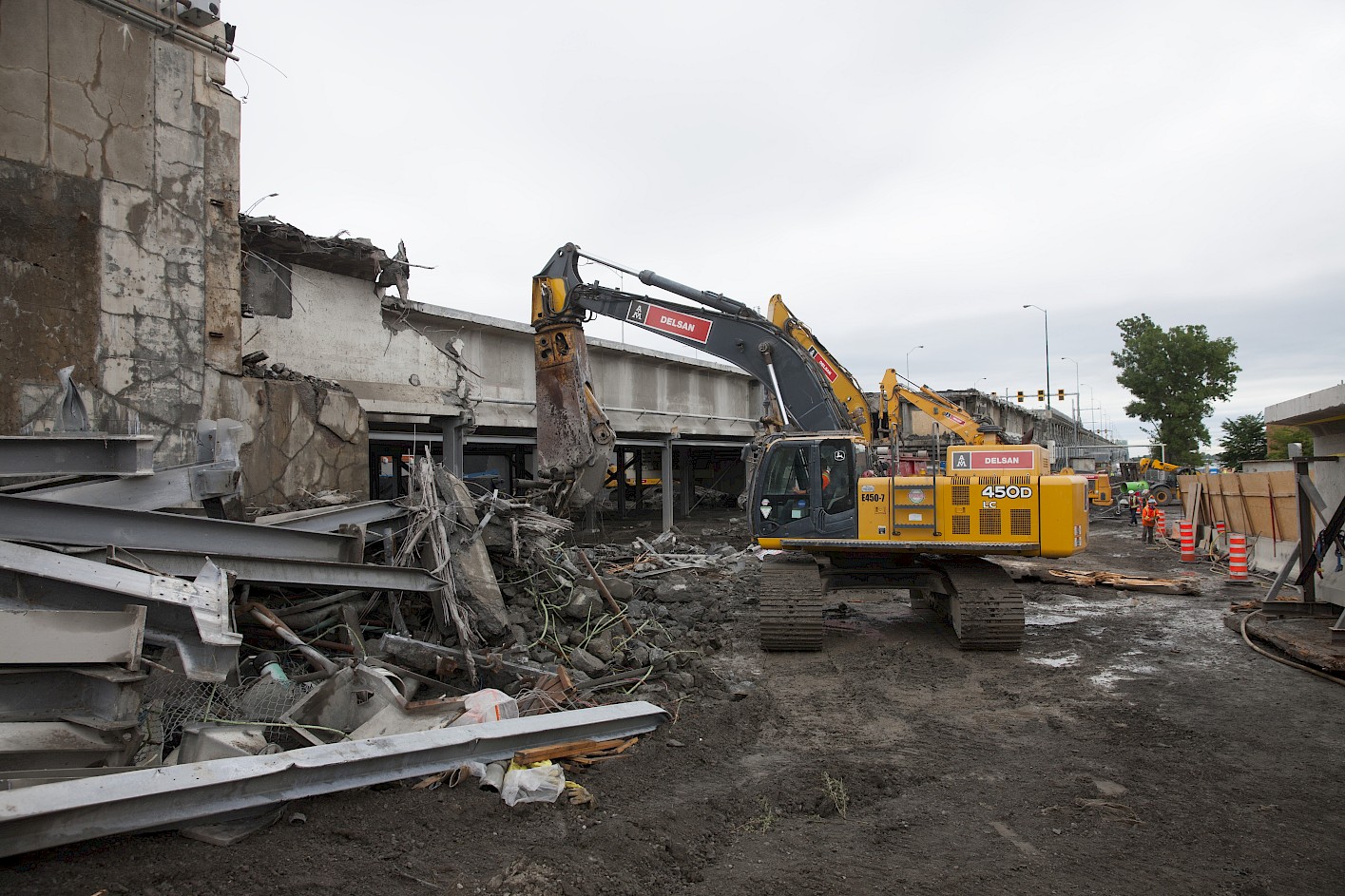
BackIn July 2020, the major deconstruction project of the original Champlain Bridge began on the Île des Sœurs side.
This work consisted of deconstructing two spans, one pier and the abutment of the sections located above René-Lévesque Boulevard.
The mechanical deconstruction of the abutment, the two spans, the pier cap, and the pier located near René-Levesque Boulevard required up to eight excavators. For example, the deconstruction of the abutment generated a total of 2,200 tons of concrete which was recycled at nearby sorting centres. Subsequently, bridge reinforcements such as the modular trusses were deconstructed.
To mitigate the nuisances caused by noise and dust, sound level meters and air quality measurement stations were installed to ensure compliance with current standards.
Credit: JCCBI
Deconstruction of the abutment at the Île des Soeurs.
Construction of temporary jetties
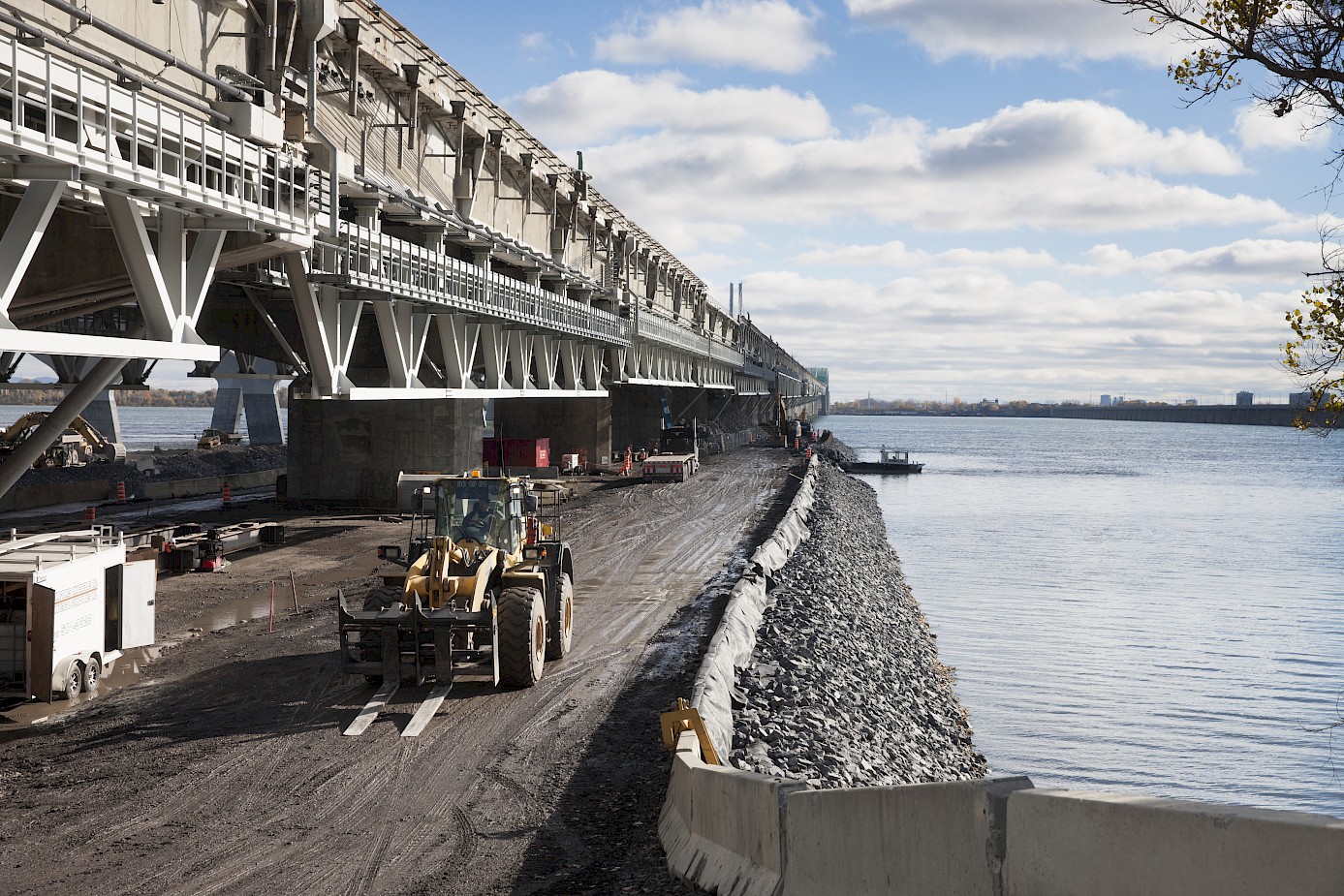
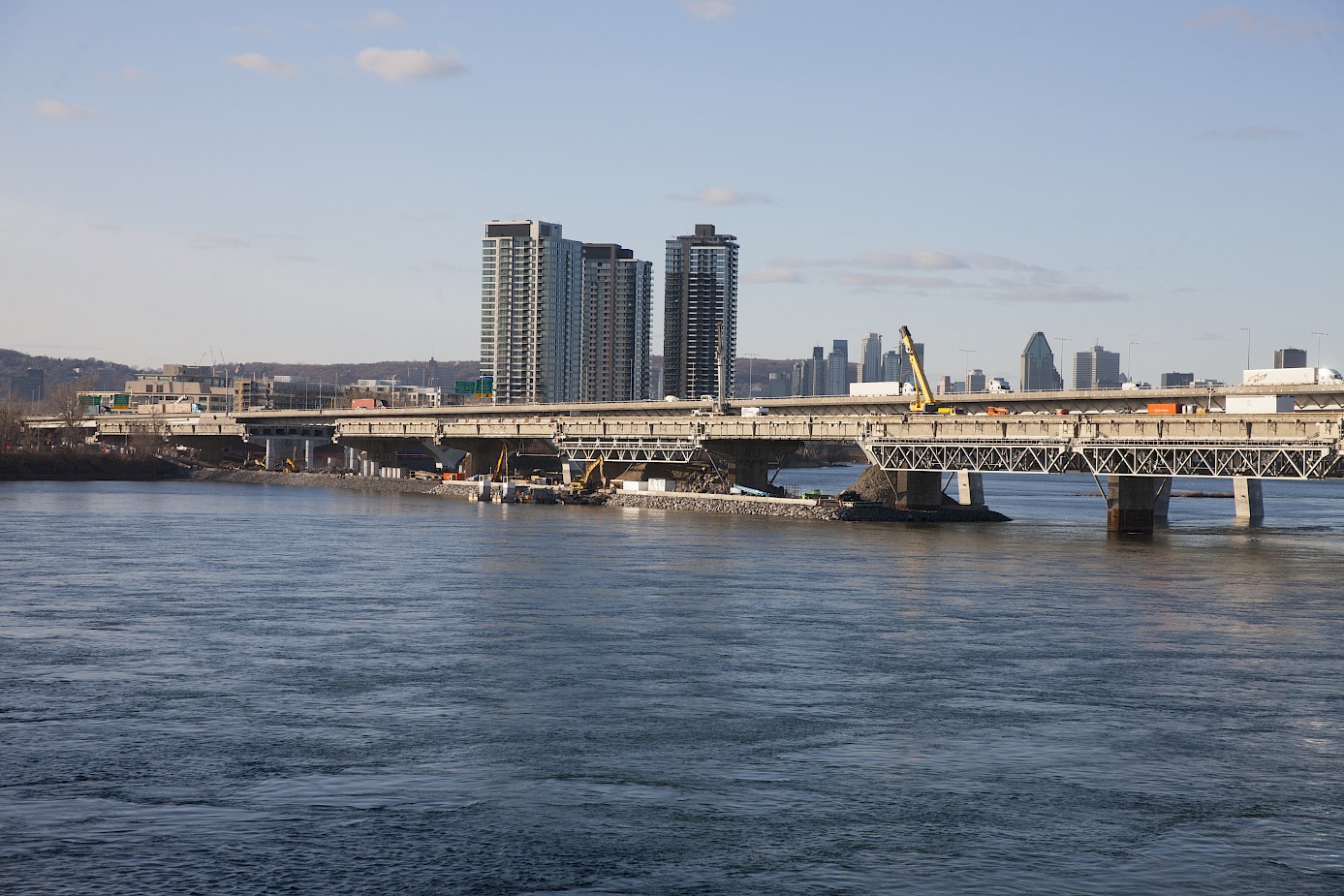
In September 2020, NHSL constructed a temporary jetty on the Île des Soeurs side. This jetty allowed for the dismantling of structural components of the bridge in areas along the shoreline where barges cannot be used due to shallow waters.
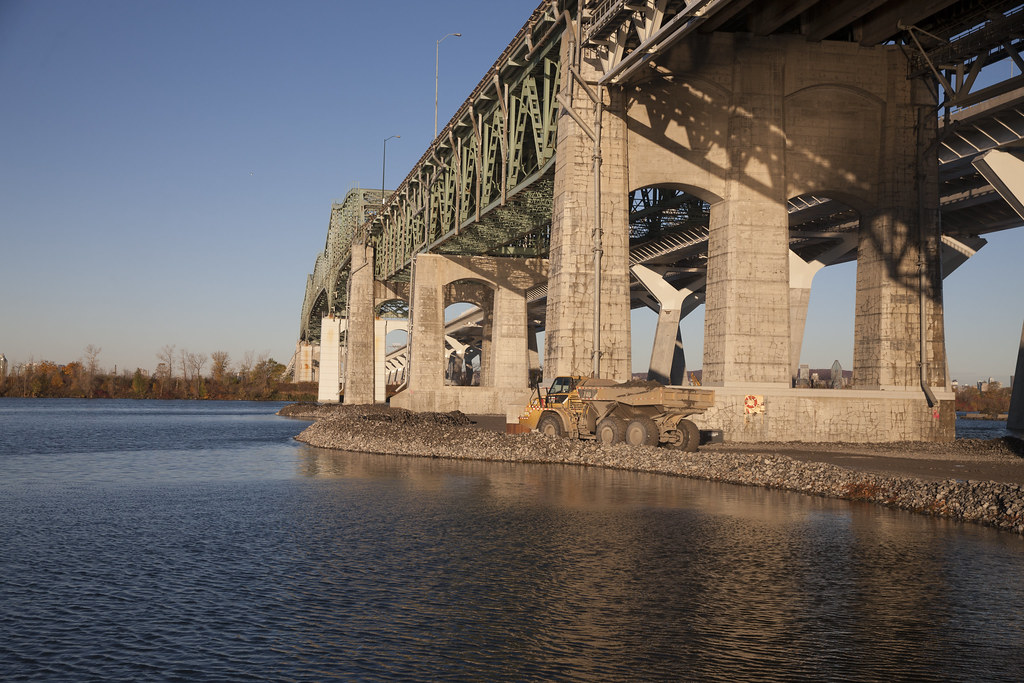
Two other jetties were necessary, one on the side of the St. Lawrence Seaway dike and the other on the Brossard side.
Credit: JCCBI
Construction of the temporary jetty on Île des Soeurs.
Credit: JCCBI
Construction of the temporary jetty on Île des Soeurs.
Credit: JCCBI
Construction of the temporary jetty in Brossard.
JCCBI is honored in Public Participation
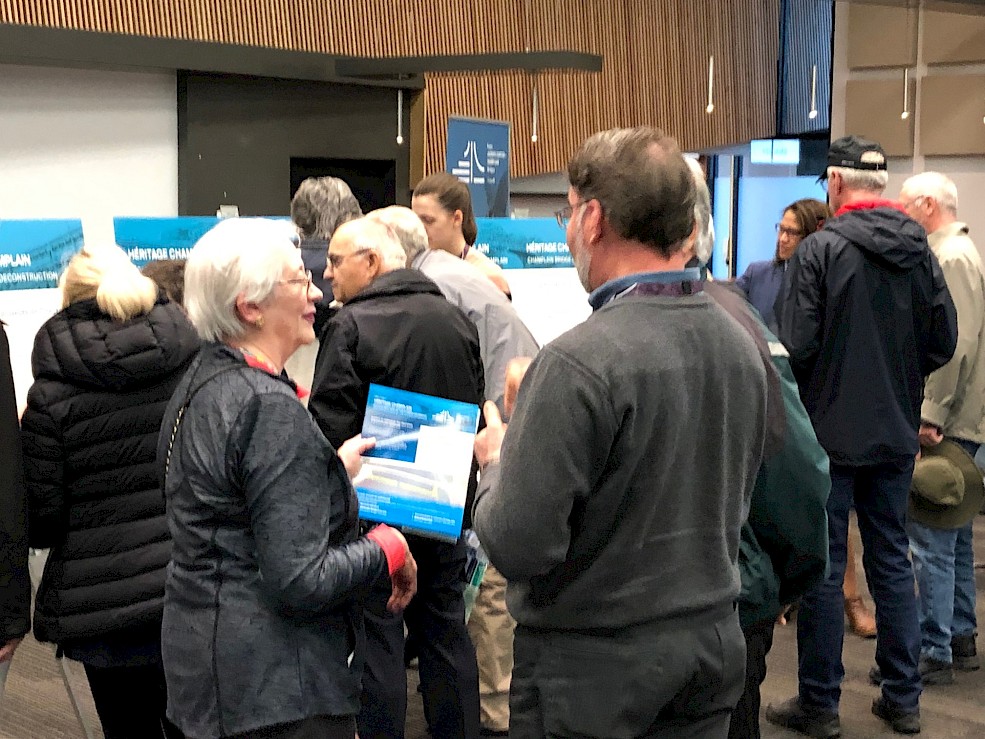
On October 1, 2020, JCCBI was honored across Canada and received an honorable mention in the “Awards for Excellence in Public Participation” from the International Association for Public Participation - Canada (IAP2 Canada).
Credit: JCCBI
Open house event.
Development of two migratory corridors for fish
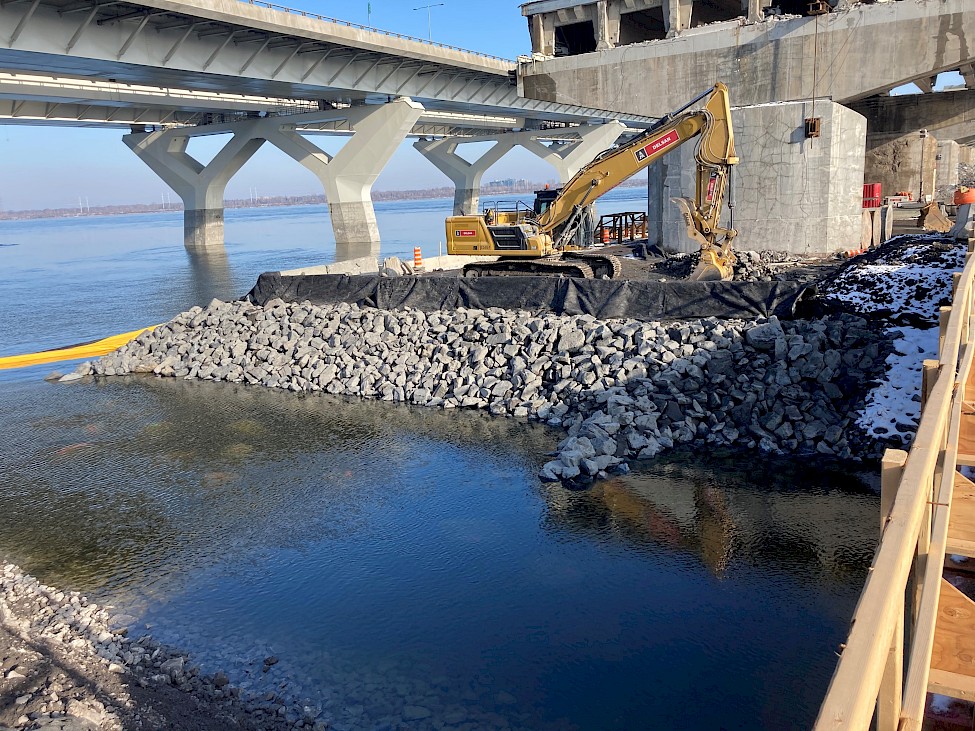
In November 2020, NHSL began the development of two fish migration corridors to mitigate the impacts of the presence of the jetty on fish and their habitat.

Credit: JCCBI
Development of two fish migration corridors.
More than 12 underwater cameras and two resistivity sensors provided biological monitoring for each corridor. In addition to counting them, the sensors were used to determine the direction of movement, approximate size, and swimming height of the detected fish. The cameras, for their part, were used to identify the family or likely species.
When designing the passes, NHSL considered many parameters to reproduce the ideal fish migration conditions:
- A constant flow had to be maintained with a speed that should not exceed 0.8 to 1.2 m/s.
- The minimum water depth had to be 0.6 m at the time of low water and the width of the corridor had to be at least 5 m.
Everything had to be built on the natural substrate across the jetty of the Île des Soeurs.
Once the corridors were in operation, they were instrumented to allow:
- Perform biological monitoring with fish counts.
- Monitor the effectiveness of hydraulic conditions.
Credit: JCCBI
Development of two fish migration corridors.
The first six months in 50 seconds
JCCBI has produced a time-lapse video showing all the work done during the first six months of the original Champlain Bridge deconstruction.
Credit: JCCBI
The first six months in 50 seconds (August 2020 to January 2021).
