


Period : 1985 - 1999
Deck replacement on the main span
BackBetween 1990 and 1993, the concrete deck on the metal span of the original Champlain Bridge was replaced with a new orthotropic steel deck.
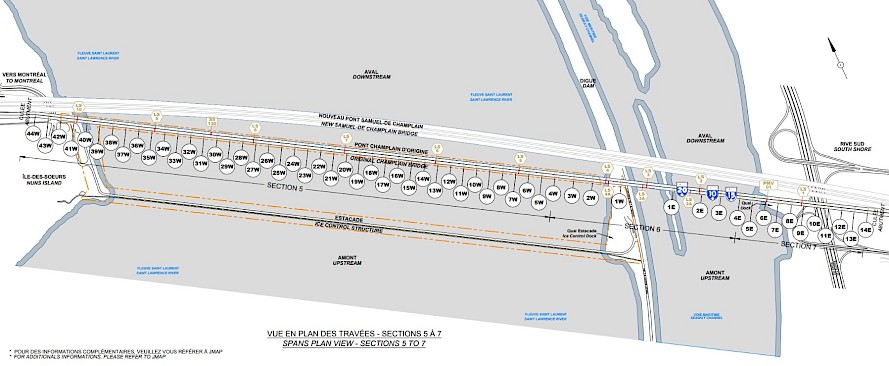
Reference map of the original Champlain Bridge to clearly locate the different sections and piers.
Recognition of JCCBI’s expertise
In 1991, the Ordre des ingénieurs du Québec (OIQ) presented JCCBI with an award, the Prix Méritas, for the exceptional quality of its work to replace the concrete bridge deck with a steel deck whose prefabricated panels could be welded together on site. This innovative approach — a first in Canada— provided an ingenious, durable and efficient means of reducing the deck’s weight.
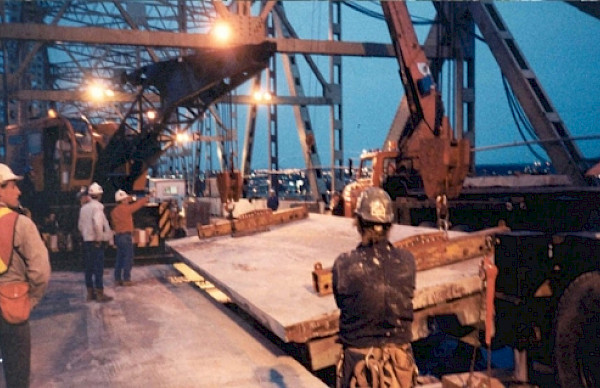
Credit: JCCBI
Deck replacement.
JCCBI had set out various requirements for the new deck. Here are a few examples:
- Installation to be completed within one year.
- New deck to be no heavier than the old one.
- New deck to have the same load capacity as the old one.
- Six lanes of traffic to be kept open at rush hour throughout the project.
- Life-cycle costs to be minimized.
- Cover surface to have a maintenance-free service life of at least 10 years.
Corrosion protection strategy
In 1993, the SLSA prepared a report titled Champlain Bridge Corrosion Protection Strategy—Sections 5 and 7.
Among other issues, the report noted that the bridge’s edge girders had been experiencing rapid deterioration since 1985. The following work had been carried out in the six previous years:
- 24 edge girders reinforced with additional post-tensioning.
- 83 of the 100 edge girders covered with a membrane on the lower half of the web and the lower footing.
- Ends of 12 girders repaired.
Virtually all of the 100 edge girders were repaired using one of the following methods:
- Crack sealing.
- Injection grouting.
- Concrete spraying.
- Spot repair or a combination of these methods.
The bridge’s expansion joints were inspected in 1991 to assess the condition of the steel components. JCCBI had been carrying out emergency repairs at a rate of two or three joints per year. In 1992, 12 joints had to be repaired.
Several options were considered to extend the service life of the bridge. Among other measures, the report recommended the following:
- Replacing the existing concrete curb and guard rail with a new concrete New Jersey-type barrier.
- Modifying the original drainage system.
- Studying the potential for implementing a cathodic protection system on certain girders.
Outer guard rails and drainage system
Originally, the bridge’s drainage system and guard rails had been configured as shown in the two photos below:
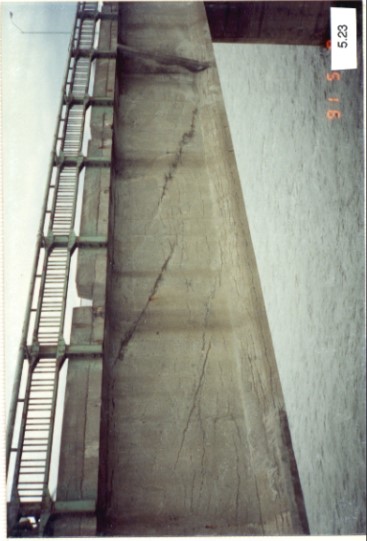
Credit: JCCBI
Condition of an edge girder displaying cracks which trace the internal post-tensioning ducts and which shows the original barrier and deck drains along its curb. Annual report inspection for 1991.

Credit: JCCBI
Equipment used in 1985 to perform a special inspection of the prestressed beams by travelling on the original concrete curb of the edge barrier.
A contract was awarded to Simard-Beaudry Construction on September 30, 1994. The firm would be responsible for replacing the original outer guard rails and drainage systems in sections 5 and 7 of the bridge. The guard rail was replaced with a concrete New Jersey-type barrier, installed one precast section at a time. The work was primarily carried out in 1994 and 1995, with some lingering issues addressed in 1996.
On the east and west approach spans, the original steel guard rails had rested on concrete curbs. They needed to be entirely replaced using a system of prefabricated concrete barriers with integrated basins and drain pipes.
Prior to this major project, drain water containing road salt had simply flowed through openings in the concrete curbs and down along the sides of the girders. Chlorides from road salts had already begun to penetrate the concrete, corroding both the steel reinforcements and the steel sheaths, causing the concrete to delaminate and crumble.
Comprehensive painting program
Selective or spot painting work began in 1972, just 10 years after the bridge was opened, and continued until 1989. A comprehensive painting program, was implemented in 1994. Covering all steel components on the Champlain Bridge structure, it would continue until 2005.
Pier-mounted instrumentation
In 1995, a report prepared by the Université de Sherbrooke described the measurements recorded by instruments installed on pier 21. The report covered the period roughly from October 15, 1994, to June 30, 1995.
Data was gathered using six crackmeters and six thermocouples. One of each monitored a crack located above the water. The remaining five crackmeters and five thermocouples monitored cracks that had been identified below the surface.
A second report was released for the period from October 15, 1994, to October 1, 1996. This was one of the first bridge monitoring projects to use remote sensing instruments.
